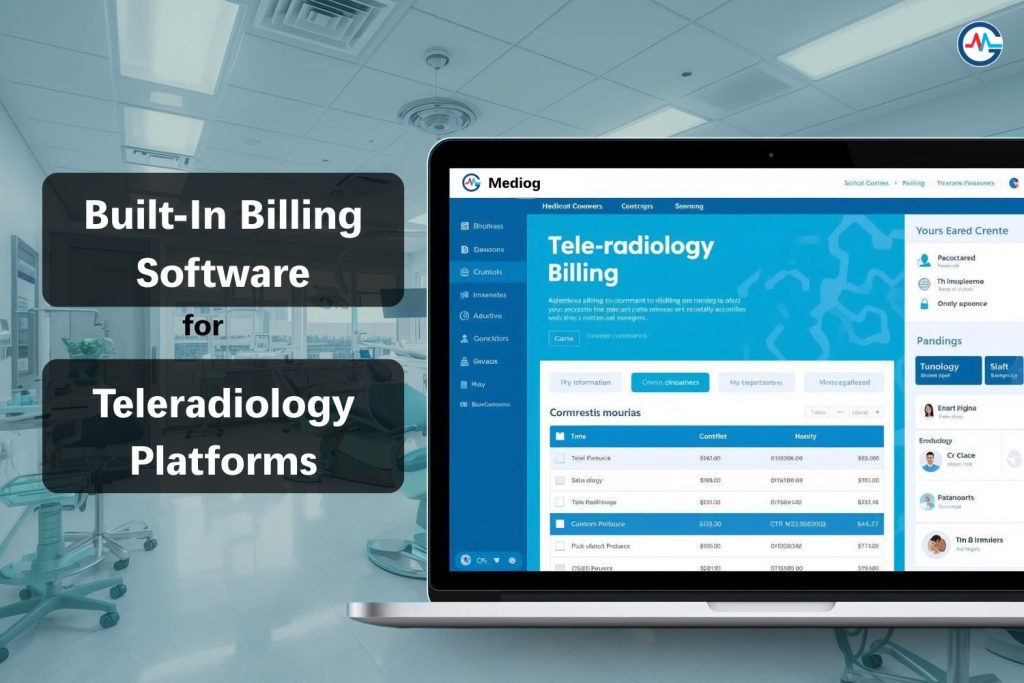
Radiology departments today handle large volumes of studies, but many still depend on separate systems for billing and reporting. This separation creates confusion, delays, and revenue loss. Modern teleradiology platforms are now solving this by including built-in radiology billing software. It links reporting, study tracking, and payments in one connected flow. This gives hospitals a clear and instant view of their financial performance.
Decision makers can see how every completed report translates into billing and revenue. Mediog brings all of this into one unified system through its PACS and RIS integration, helping hospitals maintain accuracy, speed, and transparency in daily operations.
Why Real-Time Financial Monitoring Needed in Radiology
Financial management in radiology is not just about numbers. It determines how smoothly a department can function, how fast reimbursements are received, and how effectively new equipment can be planned. Yet most hospitals still depend on delayed, fragmented billing systems. This lack of visibility often causes daily confusion and long-term revenue loss. Below are the real challenges radiology leaders face every day when financial monitoring is not real-time.
High Equipment Costs with Delayed Billing
MRI, CT, and digital X-ray machines require large investments and constant maintenance. The cost of operating them continues even when billing is stuck in the pipeline. Many hospitals discover that completed studies remain unbilled for days because of manual data transfer between reporting and finance teams. These delays freeze capital and make it difficult to justify equipment upgrades. A few missed or late claims every week may look small, but quickly add up to significant annual losses (caresoft.co.in).
Unpredictable Cash Flow Across Multiple Payment Sources
Radiology units often serve patients from private insurance, corporate tie-ups, government health schemes, and direct cash payments. Each category follows a different payment cycle and documentation requirement. When billing systems are not connected to reporting software, claims tracking becomes manual and error-prone.
Hospital accountants spend hours verifying which reports are ready for billing and which payments are still pending. Real-time tracking simplifies this process by giving an instant view of receivables and preventing end-of-month surprises (caresoft.co.in).
Revenue Leakage Due to Missed or Incorrect Entries
In many radiology departments, billing data is collected manually from daily report logs or printed requisitions. This method often leads to missing entries, incorrect patient identifiers, or duplicate bills. By the time errors are detected, days or weeks may have passed, and claim deadlines may have expired.
According to Radiology Today, relying only on retrospective financial summaries hides these small losses until they become serious problems (radiologytoday.net).
Slow Financial Response & Poor Decision-Making
Administrators who rely on weekly or monthly revenue reports often feel they are managing their department in the dark. If revenue suddenly dips or a particular modality underperforms, it may take weeks to notice. In a competitive healthcare market, this delay limits quick corrections.
As Radiology Today reported, the lack of live financial metrics leaves managers reacting to problems that could have been prevented earlier (radiologytoday.net).
Rising Costs and Declining Insurance Margins
Across the world, imaging centers face a financial squeeze. Equipment costs, service contracts, and power consumption continue to rise while insurance reimbursements decline. In such a climate, every unbilled or rejected study directly affects departmental sustainability. Real-time financial oversight helps hospital leaders identify low-performing areas and take corrective action before losses accumulate (radiologytoday.net).
Each of these challenges shows why radiology departments cannot rely on retrospective financial data anymore. Real-time visibility is not only about improving billing accuracy; it is about protecting the financial health of an entire hospital ecosystem.
How Real-Time Financial Monitoring Works
Most radiology departments already have the data they need. The challenge is that this data sits in different systems like RIS, PACS, billing tools, and hospital software, which rarely talk to each other. Real-time financial monitoring connects all of them, creating a single source of truth for both radiologists and finance administrators. It turns daily clinical activities into live financial insights that help hospital leaders act before problems grow.
Every Action Captured Instantly
In a typical radiology workflow, multiple events occur throughout the day: new patient registrations, imaging orders, completed studies, billing entries, and insurance claims. In a traditional setup, these actions are logged separately and reconciled later. With real-time monitoring, each step is captured automatically and updated across the system as it happens (caresoft.co.in). Administrators can instantly view how many studies were completed today, which ones were billed, and which claims are awaiting approval.
Integration Across PACS, RIS, and Billing Systems
Modern integration technology now allows PACS, RIS, and billing software to work together as one connected unit (radiologytoday.net). Instead of manually exporting data from each system, the information flows into a shared dashboard. This eliminates duplicate entries and keeps every report linked to its financial record. For hospital leaders, it means that a diagnostic report and its payment status can be reviewed side by side, removing confusion between the clinical and billing teams.
The Live Dashboard as a Control Center
Think of the real-time financial dashboard as the control room of the radiology department. It constantly gathers key financial signs such as total revenue generated today, pending claims, and outstanding dues (caresoft.co.in). This overview is updated continuously, giving decision-makers a live picture of their department’s health. If an issue arises, such as a sudden drop in billed studies or rising unpaid claims, the system highlights it immediately for review (auntminnie.com).
Drilling Down into Details
The real strength of real-time monitoring lies in its flexibility. Administrators can drill down into specific data points, for example, revenue from MRI versus CT, billing by individual radiologist, or performance of each hospital branch. When certain values fall outside normal ranges, the system can trigger alerts for timely intervention (caresoft.co.in). This capability not only reduces losses but also helps allocate staff and resources more effectively.
By unifying all these processes, real-time monitoring removes the need for waiting on monthly financial summaries or manual reconciliation. It allows decision-makers to manage their radiology departments with clarity and confidence.
How Mediog Simplifies Real-Time Financial Monitoring
For many hospitals, the biggest challenge is not a lack of data but the lack of connection between systems. Mediog solves this by bringing every clinical and billing process into one live, interactive platform. Its radiology billing software is built directly into the PACS and RIS workflow, meaning no manual reconciliation or delayed updates. As a result, hospitals gain the key benefits of real-time financial monitoring while keeping the process simple and automatic.
Detecting Revenue Leakages Early
In many radiology departments, unbilled studies or duplicate entries are found only during end-of-month reviews. Mediog’s live dashboard helps catch these issues the moment they occur. For example, if a completed MRI does not appear in the billing queue, the system flags it immediately (caresoft.co.in). Staff can correct errors before they affect revenue. This immediate visibility reduces missed charges, claim denials, and income loss that often go unnoticed for weeks in manual setups.
Maintaining Smooth Cash Flow
Hospitals often struggle with delayed reimbursements and unsettled patient dues. Mediog’s continuous tracking of every claim, payment, and refund helps keep the process transparent. It displays the current billing status of all studies in real time, helping staff follow up on pending claims without waiting for finance reports (caresoft.co.in). In India, this kind of live claim monitoring has helped hospitals reduce settlement cycles and maintain stable operating capital. For hospital heads, this means fewer revenue backlogs and stronger control over cash flow.
Improving Operational Efficiency
Because Mediog connects both financial and operational data, administrators can easily identify performance gaps. The dashboard shows the revenue generated by each imaging modality, radiologist, or location. If an MRI scanner runs at full capacity while another machine remains underused, Mediog highlights this imbalance instantly (caresoft.co.in). Managers can then reassign staff or adjust scheduling. This ensures that expensive equipment is fully utilized, which improves productivity and overall profitability.
Enabling Data-Driven Decisions
Real-time numbers help hospital leaders make confident decisions. Mediog provides up-to-the-minute information on study volume, daily revenue, and cost per modality, allowing decision-makers to plan expansions or equipment upgrades based on accurate insights (drlogy.com). For instance, before investing in a new CT scanner, administrators can check the current utilization rate and expected ROI directly from the dashboard. Experts note that such data-driven tools have become one of the strongest supports against rising costs and shrinking reimbursements (radiologytoday.net).
Promoting Transparency and Accountability
When financial data is updated in real time and shared across the right teams, everyone becomes more responsible for results. Mediog’s live dashboard allows radiologists, billing clerks, and administrators to see performance against targets as it happens (caresoft.co.in). This shared visibility creates accountability without adding administrative burden. Managers can quickly identify where delays occur and address them before they affect patient billing or departmental revenue.
Enhancing Patient Experience
Billing errors and confusion can damage patient trust. Mediog’s automated billing linkage ensures that every report is billed correctly and promptly, reducing waiting times and financial disputes. Patients receive accurate, transparent billing at the time of discharge, improving their overall experience (caresoft.co.in). Over time, this reliability builds confidence in the hospital’s service quality and strengthens its reputation for fair and efficient care.
Supporting Long-Term Growth
As hospitals expand to new branches or diagnostic centers, keeping track of finances becomes harder. Mediog’s cloud-based system scales easily, providing a single financial view for all sites. Administrators can monitor ROI for each modality, analyze trends, and plan resource allocation for sustainable growth (drlogy.com). Real-time financial clarity ensures that even as patient volume grows, profitability and control are never lost.
Conclusion
Radiology departments no longer need to wait for delayed reports or manual reconciliations to understand their financial position. The way forward lies in using integrated tools that connect imaging, reporting, and billing in one live system. Mediog provides this clarity through its built-in radiology billing software, allowing hospitals to manage costs, track revenue, and plan growth in real time. For decision-makers aiming to strengthen both clinical and financial performance, adopting such unified technology is the most practical next step.
###