Every hospital knows the frustration of delay. A patient waits for an urgent scan report, the doctor waits for images to load, and the radiologist juggles between systems that don’t talk to each other. These small delays often stretch into critical gaps in patient care. The real issue isn’t lack of skill or technology but lack of connection.
Modern radiology depends on how well its two main systems, PACS and RIS, work together. When images, patient data, and reports move in one smooth line, diagnosis becomes faster, communication clearer, and patient trust stronger. This blog explains how PACS RIS integration builds that connection, and turns isolated systems into one powerful, coordinated workflow that forms the true backbone of teleradiology.
1st Pillar: PACS, The Image Backbone of Modern Radiology
Picture Archiving and Communication System (PACS) is where every medical image truly begins its digital life. It stores, retrieves, and shares diagnostic images across hospitals, clinics, and remote radiology networks. In teleradiology, PACS acts as the bridge that connects imaging devices to radiologists, no matter where they are. From an MRI machine in Mumbai to a radiologist’s workstation in New York, PACS ensures that every scan is instantly available for expert review.
Suggested Read: What’s the Role of PACS in Radiology & Medical Imaging?
In recent years, the U.S. FDA has introduced the term Medical Image Management and Processing System (MIMPS) as a broader evolution of PACS. MIMPS reflects how today’s systems go beyond simple archiving to include advanced processing, AI-assisted detection, and multi-planar 3D visualization. It represents the next step in radiology imaging, where data is not only stored but intelligently interpreted and shared in real time. MIMPS therefore captures the true nature of modern teleradiology. Read more about MIMPS here.
Key impacts of a well-integrated PACS system:
- Faster image availability: Integrated modality–PACS workflows reduce manual uploads and make scans accessible in near-real time.
- Improved diagnostic accuracy: Built-in AI tools can flag abnormalities like bleeds or nodules seconds after acquisition, improving early detection.
- Global accessibility: Cloud-based PACS enables cross-location reading and supports 24/7 teleradiology coverage, vital for hospitals handling emergency or night shifts.
- Reduced reporting delays: Hospitals using AI-enabled PACS have cut average turnaround from hours to under 45 minutes, boosting patient confidence and operational efficiency.
- Seamless collaboration: Shared PACS archives let radiologists, surgeons, and clinicians access the same image set, ensuring consistent communication and treatment decisions.
In short, PACS is not just a storage system, it’s the operational foundation that makes connected and timely diagnosis possible in the era of teleradiology.
2nd Pillar: RIS, The Departmental Workflow Brain
If PACS is where images live, the Radiology Information System (RIS) is what keeps the entire process organized. It manages patient data, schedules, reporting, and billing. In a teleradiology setup, RIS ensures that no study is misplaced, no report is delayed, and every patient case is traceable from order to delivery.
When RIS and PACS work in sync, radiologists don’t have to jump between systems to find patient details or track reports. The workflow becomes structured, auditable, and time-efficient. For hospital administrators, this integration brings visibility into every stage of radiology, from scheduling to report dispatch, making quality control and performance monitoring easier than ever.
Key impacts of a robust RIS system:
- Smarter scheduling and triage: Automated RIS tools can prioritize urgent imaging cases, reducing patient wait times and optimizing resource use.
- Transparent tracking: Every order, image, and report is linked under one digital case ID, helping prevent missing studies or duplicate exams.
- Structured reporting: AI-assisted and voice-recognition templates inside RIS speed up report creation while maintaining clinical consistency.
- Improved communication: Integration with EHR and alert systems allows instant result sharing with referring doctors and patients, improving clinical coordination.
- Performance analytics: Real-time dashboards inside RIS help hospital leaders track turnaround times, detect workflow bottlenecks, and make data-driven staffing decisions.
In essence, RIS provides the organizational intelligence that powers modern radiology. When it communicates seamlessly with PACS, every imaging study moves through the system with clarity, speed, and accountability.
Suggested Read: Radiology Information System (RIS) – Everything You Need to Know
How the Integration Happens Between PACS & RIS
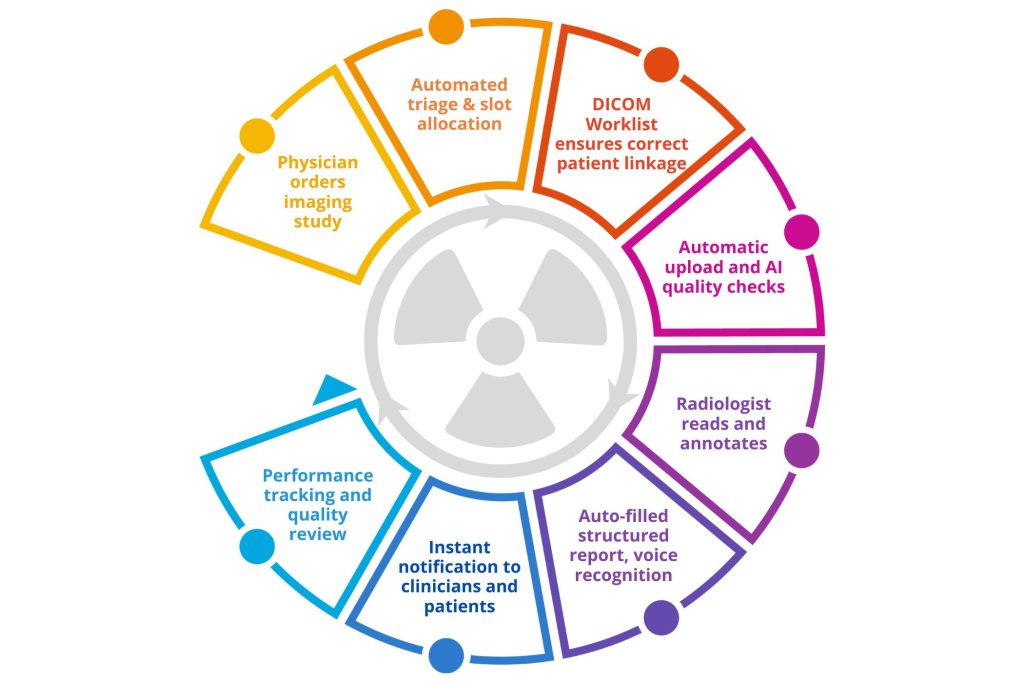
Integration between PACS and RIS is what transforms radiology from a collection of tools into a unified system of care. Without integration, radiologists work in fragments, like images on one screen, patient data on another, and reports somewhere else. When these systems communicate seamlessly, information flows as one continuous stream. Orders, images, and reports align perfectly, reducing duplication, errors, and time loss. In modern teleradiology, this integration is the foundation that keeps global imaging operations efficient, traceable, and secure.
Data Connectivity Through DICOM and HL7 Standards
PACS and RIS communicate with each other using two international standards: DICOM for images and HL7 for patient and administrative data. When an imaging order is placed in RIS, the DICOM Modality Worklist ensures that the same patient information appears on the scanner, preventing human error during data entry. Once the scan is done, images move automatically into PACS, where radiologists can read them along with complete demographic and clinical context.
This link between RIS and PACS removes redundancy. Radiologists don’t have to match files manually; the system ensures the right image belongs to the right patient every time. Hospitals that achieved full DICOM–HL7 interoperability reported smoother workflows and fewer data mismatches.
Automation in Scheduling, Reporting, and Delivery
When integration is deep, RIS not only sends imaging orders to PACS but also automates triage and scheduling. High-priority studies are flagged first, while non-urgent ones queue automatically. Once images reach PACS, structured reporting tools embedded in RIS can auto-populate patient information, saving time in documentation.
For radiologists, this integration means more focus on interpretation and less on administration. In Indian and U.K. hospitals, AI-enabled RIS–PACS automation cut average report turnaround from six hours to under forty-five minutes. The outcome was faster reporting, better patient satisfaction, and stronger operational trust between departments.
One Unified Workflow for Radiology Teams
Integration breaks down silos between clinicians, technologists, and radiologists. When data, images, and reports share one synchronized database, everyone sees the same information, whether it’s a technician at the scanner, a radiologist at home, or a physician in the ward.
This shared visibility improves decision-making and accountability. At Nyack Hospital in the U.S., integrated workflow monitoring helped identify reporting delays early and reduced inpatient stays through faster imaging completion. It proved that data transparency directly improves hospital performance.
Analytics and Continuous Quality Monitoring
RIS–PACS integration also opens the door to real-time analytics. Dashboards track key indicators like turnaround time, modality utilization, and report accuracy, enabling hospital executives to manage performance proactively. Instead of waiting for monthly reviews, radiology leaders can see workflow bottlenecks live and take immediate action.
These insights are vital for value-based care environments, especially in U.S. and U.K. systems, where reimbursement and patient satisfaction depend on measurable outcomes.
The Greatest Impact Is Seen When PACS & RIS Collabs
Global Impacts of PACS–RIS Integration
Across the world, integrated radiology systems have moved from being an innovation to becoming an operational necessity. In the United States, hospitals are using PACS–RIS integration to align with value-based care models. By linking imaging data, scheduling, and reporting under one workflow, radiology departments have shortened report turnaround times and reduced inpatient stays, directly contributing to hospital efficiency and patient throughput. Many U.S. centers now pair their PACS with analytics dashboards that track performance in real time, helping executives make faster operational decisions.
In the United Kingdom, the NHS has taken integration a step further by building nationwide imaging networks. Shared PACS–RIS platforms allow radiologists across hospitals to read from unified worklists, addressing the country’s 29% radiologist shortage. Meanwhile, in India, integrated teleradiology and automation platforms have allowed busy diagnostic centers to cut report turnaround from 6 hours to under 45 minutes. These examples show that no matter the healthcare system’s size, the outcome is the same, better speed, accuracy, and access through a connected radiology ecosystem.
Mediog Excels in Providing Advanced PACS Solutions
At Mediog, integration is built into the core of our technology. Our cloud-based PACS and RIS system is designed for hospitals, diagnostic centers, and teleradiology providers who value both speed and reliability. From automatic DICOM routing to secure report sharing, Mediog ensures every image and report flows through one connected channel.
With support for MPR, 3D visualization, and AI-assisted quality checks, Mediog helps radiologists focus on interpretation instead of manual coordination. Hospitals using Mediog’s integrated platform experience faster reporting, easier collaboration, and higher patient satisfaction. Whether it is for single-site hospitals or large teleradiology networks, Mediog offers a scalable, future-ready solution that turns data connection into diagnostic confidence.
Suggested Read: AI Reporting for Radiologists: One-click draft for accuracy & time management
Conclusion
Radiology thrives when technology and workflow move together. PACS–RIS integration is no longer a choice but the path to faster, safer, and more reliable diagnostics. For hospitals and imaging centers aiming to modernize their radiology operations, Mediog provides a unified platform that connects every step of the process, from image capture to report delivery, turning efficiency into everyday practice.
###