A few years ago, radiology rooms were filled with shelves of X-ray films, and doctors had to wait for hours to access a single image. Today, those films have been replaced by digital screens, where radiologists can view, compare, and share medical images in seconds. This change became possible because of PACS, or Picture Archiving and Communication System.
PACS has turned radiology into a faster, more connected, and more accurate process. It allows hospitals and diagnostic centers to store, retrieve, and share medical images safely across departments or even cities. Whether it is an X-ray, CT, or MRI, PACS helps doctors see everything clearly, without worrying about lost films or delays. In modern medical imaging, PACS is no longer an option; it is the foundation of efficient healthcare.
What Is PACS?
Picture Archiving and Communication System is a digital method for storing and managing medical images. Instead of depending on printed films or CDs, hospitals now keep every scan in a secure computer network. From X-rays and CT scans to MRIs and ultrasounds, all images are saved in digital form and can be retrieved anytime by authorized users.
Each image is stored in a standard format called DICOM (Digital Imaging and Communications in Medicine). This allows different imaging machines and software to communicate easily. PACS also connects with other hospital systems such as RIS (Radiology Information System) and HIS (Hospital Information System), ensuring that patient records, scan results, and reports stay linked and accessible from one place.
Key Features of a PACS System
- Centralized digital storage for all radiology images
- DICOM-based compatibility with all imaging equipment
- Secure user access for radiologists, technicians, and clinicians
- Easy integration with RIS and HIS platforms
- Quick retrieval and comparison of past patient scans
- Remote image viewing through web or cloud access
Note: According to the U.S. Food and Drug Administration (FDA), PACS is now recognized as part of the broader Medical Image Management and Processing System (MIMPS) category. In simple terms, it means PACS has evolved beyond image storage to include tools that support image processing, review, and analysis within the same digital environment.
Know more About MIMPS >> What Is MIMPS in Radiology (New Name for PACS?)
How PACS Impacts Radiology Workflow?
In radiology, time and accuracy define patient care. Earlier, film handling and manual transfers delayed results and limited coordination. PACS changed this entirely. It connects scanners, systems, and doctors through one digital workflow, enabling instant image access, faster reporting, and real-time collaboration across hospital departments and remote locations.
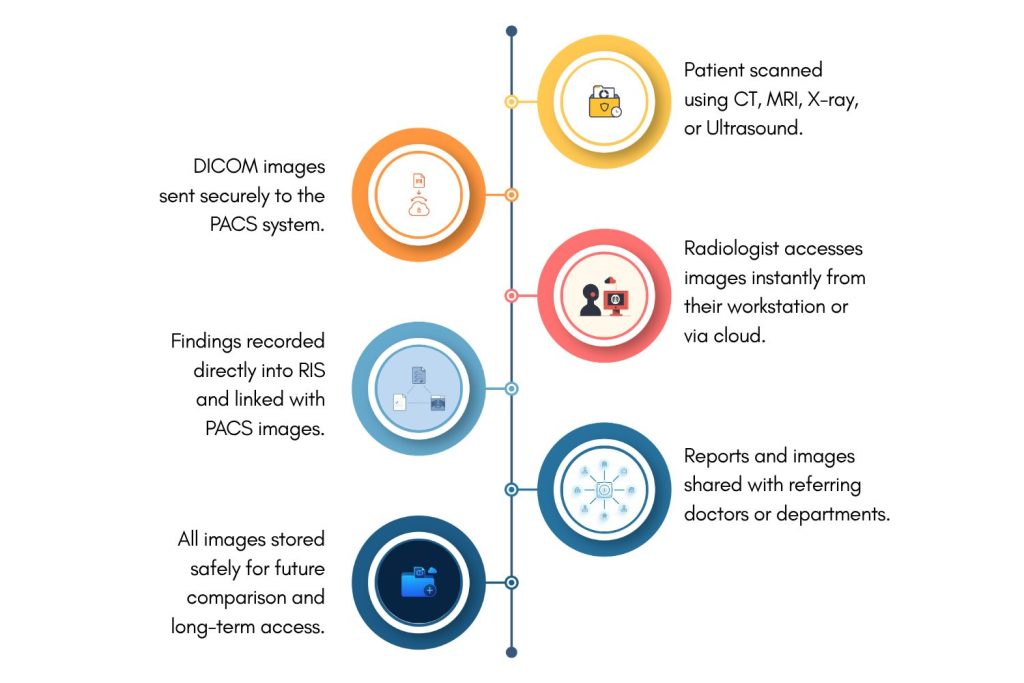
How PACS Simplifies Radiology from Scan to Report
How PACS Helps Hospitals & Diagnostic Centres?
The introduction of PACS has transformed how hospitals and diagnostic centres operate, shifting imaging from a manual, film-based process to a digital, data-driven system. Today, over 72% of hospitals worldwide use PACS in radiology, cardiology, or orthopaedics, and more than 70% of new PACS installations are now cloud-based (Source: Industry Research). This wide adoption shows how deeply PACS influences not just image storage but the overall quality, speed, and coordination of patient care.
1. Centralized Image Storage & Instant Access
Before PACS, retrieving a patient’s X-ray or MRI from physical archives could take hours, delaying treatment. Today, images are available within seconds from a digital archive. Multiple clinicians, like radiologists, surgeons, or referring physicians, can access the same image simultaneously from different locations, enabling real-time collaboration.
PACS also eliminates the risk of lost or damaged films through redundant digital backups and disaster recovery systems, ensuring image security even in unforeseen events (Source: Saince). For Indian hospitals with high imaging volumes, such as Desun or Apollo, this means every study remains accessible for years, aiding follow-up comparisons and improving diagnostic precision.
2. Faster Diagnosis and Improved Clinical Outcomes
PACS reduces report turnaround times dramatically by making images available immediately after scanning. Radiologists can analyze and annotate results without waiting for film processing. Studies show that integrating PACS with RIS improves reporting speed and overall patient throughput.
For instance, the Children’s Hospital of Alabama reported a 40% increase in radiologist productivity after implementing a digital RIS–PACS system, even while operating with fewer radiologists (Source: Radiology Business).
Indian examples confirm this trend. A diagnostic centre in Bengaluru achieved an 80% faster image-sharing rate and 50% reduction in reporting time after adopting cloud PACS (Source: SAINCE). This improvement is critical in emergency and trauma settings where rapid access to CT or MRI results can save lives.
Beyond speed, PACS enhances diagnostic accuracy. Advanced tools like zoom, 3D reconstruction, and brightness control help radiologists detect subtle findings that might be missed on film. AI-integrated PACS systems can even flag critical results automatically, improving diagnostic confidence by up to 35% faster reporting in early deployments (Source: Industry Research).
3. Operational Efficiency and Collaboration
Digitization has made hospital workflows more efficient. With PACS, radiologists no longer waste time handling films, searching archives, or physically delivering reports. One U.S. hospital recorded a 40% rise in departmental productivity after full PACS integration (Source: Radiology Business). In India, this translates into faster bed turnover and improved coordination between diagnostic units and treating doctors.
PACS also enables remote reading and 24/7 coverage, allowing radiologists to review studies from home or across branches during off-hours. This flexibility proved essential during the COVID-19 pandemic, when 91% of radiology practices worldwide relied on remote PACS access to maintain continuity of care (Source: JACR).
In multi-site networks, PACS acts as a bridge between departments. A chain of clinics can send all scans to a central PACS, allowing radiologists to balance workloads and ensure consistent reporting. This interconnected workflow supports tele reporting radiology and online X-ray reporting for distant clinics and rural health setups.
4. Financial and Strategic Advantages
The financial impact of PACS adoption is equally significant. By eliminating film, chemicals, and manual handling, hospitals can save tens or hundreds of thousands of dollars annually. A U.S. case study from Mercy Medical Center reported over $2.1 million saved in two years, alongside a 40% boost in radiology revenue per radiologist (Source: Niroggyan).
Savings are not limited to large hospitals. Mid-sized diagnostic centres gain long-term benefits through reduced repeat exams, minimal physical storage costs, and fewer staff needed for archive management. In India, the cost of PACS adoption continues to fall, making it accessible even for tier-2 hospitals. This financial sustainability helps private centres attract more patients through teleradiology services and remote consultation offerings, strengthening their competitive position.
5. Technological Readiness and Cloud Scalability
Modern PACS platforms are built to evolve. Cloud-based systems allow hospitals to scale easily as imaging volumes grow. More than 64% of new PACS installations worldwide between 2022 and 2025 were deployed as SaaS models, emphasizing flexibility and affordability (Source: Industry Research).
Technologically, PACS integrates with EHRs, HIS, and RIS, providing a seamless exchange of patient data across systems. Hospitals using vendor-neutral archives achieve up to 89% interoperability, reducing compatibility issues between imaging devices and ensuring consistent access to DICOM images (Source: Industry Research).
Data security remains a core strength. Nearly 78% of hospitals worldwide have adopted encryption and cybersecurity protocols within their PACS environments to prevent data breaches and ensure patient privacy. For healthcare providers in India, where telemedicine and remote reporting are rapidly growing, cloud PACS ensures both accessibility and compliance.
Mediog’s Cloud PACS: A Smarter Way to Manage Radiology
Hospitals today need imaging systems that are not just fast but also flexible and dependable. Mediog’s Cloud PACS is built to meet that exact need. It combines image archiving, remote access, and real-time reporting into one easy-to-manage platform. Instead of investing in heavy hardware or complex maintenance, hospitals can store and access all their radiology data securely through the cloud.
Mediog’s PACS software is designed for both large hospitals and diagnostic centres:
| It allows radiologists to view DICOM images, prepare reports, and share them instantly with doctors or departments, all from a web browser. | The system also integrates naturally with RIS and HIS, helping administrators manage imaging and patient information from a single dashboard. |
What makes Mediog’s solution stand out is its reliability. Reports are delivered quickly, images load instantly, and data remains protected with advanced encryption. For hospital teams, this means fewer delays, clearer communication, and greater confidence in daily operations.
Many reputed healthcare organizations now trust Mediog’s teleradiology and Cloud PACS system, including Dishari Health Point, Desun Hospital, Suraksha Clinic & Diagnostics, Gooddays Diagnostic, Kolkata Kidney Institute, and Apollo Diagnostics. Their adoption of Mediog reflects a growing shift toward smarter, cloud-connected radiology across India.
Conclusion
Digital imaging is now the heartbeat of modern healthcare, and PACS is what keeps it running smoothly. Hospitals and diagnostic centres that still rely on manual or semi-digital systems often face avoidable delays, storage hassles, and coordination gaps. The solution lies in adopting a dependable cloud-based PACS that brings speed, accuracy, and access together.
Mediog’s Cloud PACS offers that balance perfectly. It is secure, fast, and designed for real-world hospital needs. From remote image access to instant reporting and reliable data protection, it helps medical teams focus on care instead of technology. For decision-makers aiming to upgrade their imaging systems, Mediog provides a ready, proven path toward efficient and fully connected radiology.

Frequently Asked Questions (FAQs)
1. What is PACS in radiology?
PACS, or Picture Archiving and Communication System, is a digital platform used in radiology to store, retrieve, and share medical images electronically. It replaces traditional film-based systems with centralized digital archives. Hospitals and diagnostic centres use PACS to access X-rays, CT scans, and MRIs instantly, improving workflow speed, collaboration, and overall diagnostic accuracy.
2. How is PACS used in teleradiology?
PACS is the foundation of teleradiology software, enabling radiologists to access and interpret medical images from anywhere. Through secure cloud-based systems, doctors can perform online X-ray reporting and remote consultations in real time. This allows hospitals and diagnostic centres to maintain continuous radiology coverage, reduce reporting delays, and provide timely diagnoses, even across multiple locations.
3. What are DICOM images in PACS?
DICOM, or Digital Imaging and Communications in Medicine, is the universal standard used by PACS for storing and transferring medical images. It ensures that data from different imaging devices, like CT, MRI, or ultrasound, remain compatible and accessible across hospital systems. DICOM enables smooth integration between PACS, RIS, and HIS, improving data sharing and clinical efficiency.
###