Medical imaging has grown into the backbone of modern healthcare, with hospitals generating and storing thousands of scans every day. Managing this vast amount of imaging data has always been a challenge, especially when different systems and vendors are involved. Traditional solutions like PACS (Picture Archiving and Communication Systems) have served their role well, but their limitations are becoming more visible as healthcare networks expand.
Today, decision-makers are looking for solutions that not only store images but also ensure interoperability, long-term access, and flexibility across departments and branches. This is where the concept of a Vendor Neutral Archive (VNA) comes into focus. A VNA provides a secure, centralized, and system-independent way of managing imaging data, setting a new benchmark for efficiency in hospital workflows.
What Is a Vendor Neutral Archive (VNA)?
A Vendor Neutral Archive (VNA) is a medical imaging management system designed to store, organize, and share imaging data independently of the vendor that originally created it. Unlike traditional PACS, which often lock hospitals into one vendor’s ecosystem, a VNA operates with an open and standardized architecture. This ensures that data from different imaging modalities, CT, MRI, ultrasound, or X-ray, can all be stored and accessed in a uniform format, regardless of which machine generated them.
The strength of a VNA lies in its interoperability. Hospitals often work with multiple imaging systems from different manufacturers, leading to silos of data that are hard to integrate. A VNA eliminates these barriers by converting proprietary formats into standardized ones like DICOM, making every study easily retrievable across branches, departments, or even partner institutions. This not only simplifies data management but also extends the life of archived studies by preventing vendor lock-in.
How a VNA Works in Medical Imaging
To understand how a VNA functions, it helps to see it as a bridge between imaging systems and clinical users. The workflow typically looks like this:
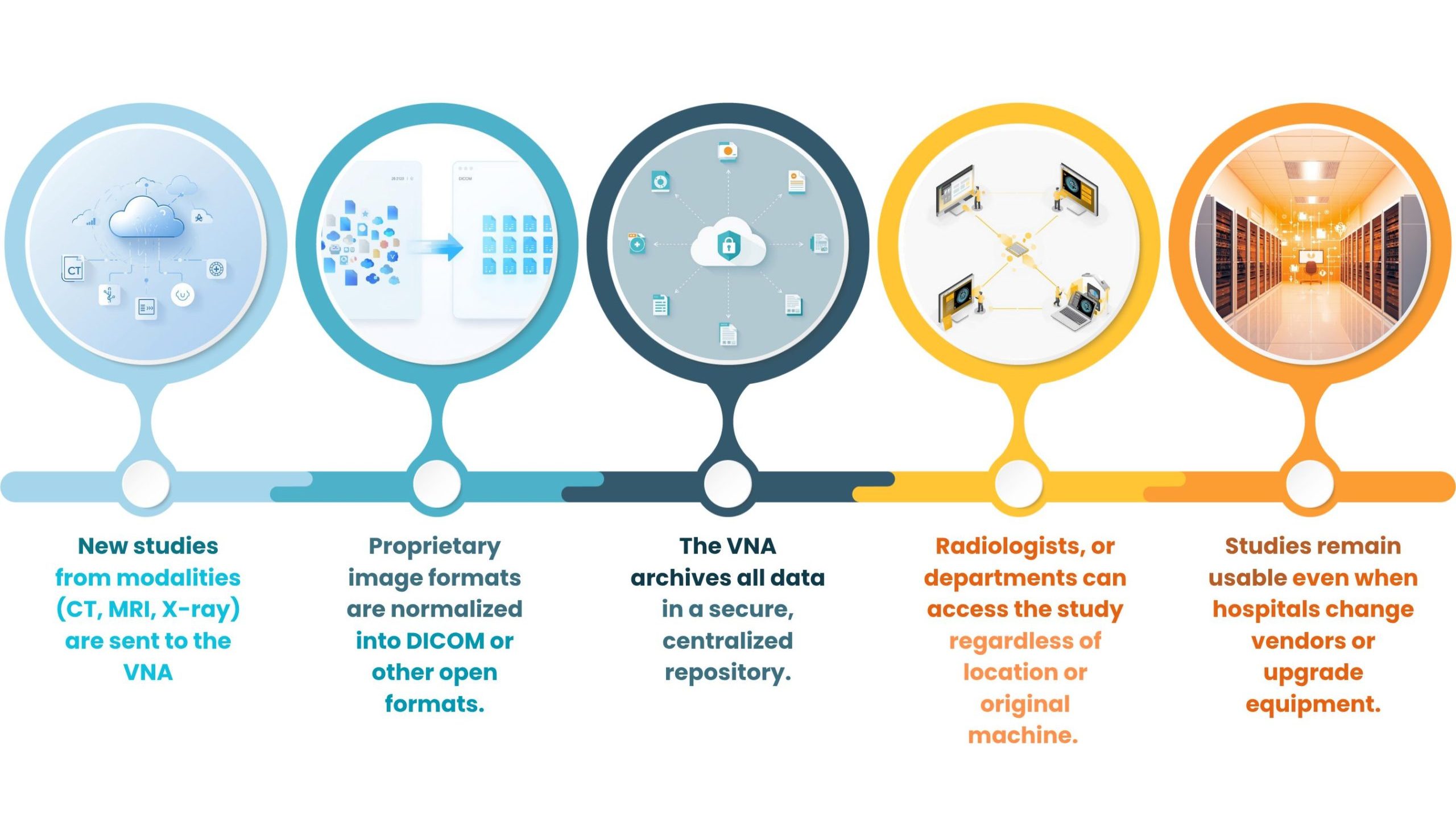
Steps of VNA
Challenges with Traditional PACS That VNA Solves
| Problems with Traditional PACS | How VNA Solves Them |
| Hospitals using traditional PACS are often locked into a single vendor’s ecosystem, making it costly and complex to switch providers or integrate new systems. | A Vendor Neutral Archive removes vendor lock-in by supporting open standards, allowing hospitals to integrate imaging data from multiple providers without disruption. |
| Proprietary formats in PACS limit interoperability, making it difficult to share studies across departments, branches, or external networks. | VNA standardizes all imaging into DICOM or compatible formats, ensuring seamless data sharing and collaboration between departments, branches, and partner hospitals. |
| Expanding PACS to multiple sites or branches often requires separate installations, leading to higher costs and fragmented data silos. | VNA provides centralized, scalable storage that supports multi-site access, enabling hospitals to expand networks without duplicating infrastructure. |
| Data archived in PACS may become inaccessible when vendors update or retire their systems, putting long-term imaging records at risk. | VNA ensures long-term accessibility by maintaining data in standardized formats that remain usable even after vendor or technology changes. |
| Collaboration between clinicians is limited with PACS due to system incompatibility and restricted access options. | VNA improves collaboration by offering secure, system-independent access to studies, enabling clinicians across locations to view the same imaging data without barriers. |
The shift from PACS to VNA offers hospitals more than just technical relief. It provides a foundation for better patient care and smoother clinical operations. By ensuring long-term accessibility, eliminating vendor dependency, and enabling cross-department collaboration, VNAs create a more resilient imaging environment. For decision-makers, this means reduced risk in technology investments and greater flexibility in choosing future solutions without disrupting existing workflows.
Why Hospitals Should Adopt VNA Now
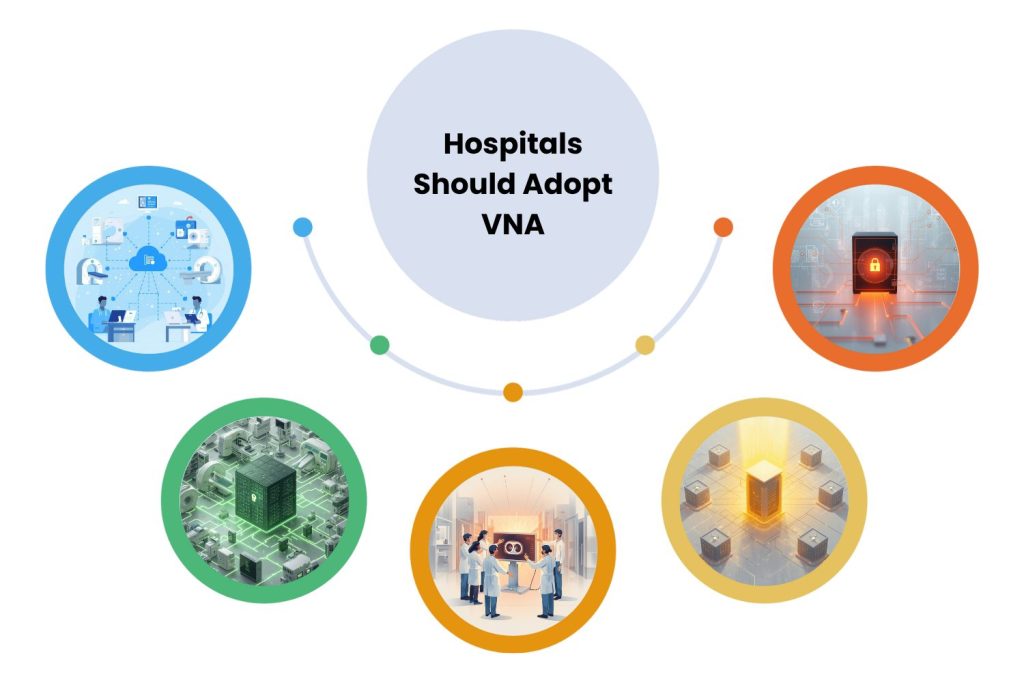
The healthcare environment is evolving rapidly, and relying solely on traditional PACS can limit a hospital’s ability to scale and adapt. A Vendor Neutral Archive (VNA) provides the flexibility, security, and long-term stability that modern imaging management requires. Below are the most compelling reasons why adopting VNA should be a priority.
Improved Interoperability Across Systems
Hospitals often work with multiple imaging modalities and systems from different vendors. Traditional PACS restrict cross-platform sharing, leading to fragmented workflows. With VNA, all data is standardized and stored in open formats, ensuring compatibility across systems. This allows physicians and radiologists to collaborate without being hindered by technical barriers.
Future-Proofing Imaging Investments
Every hospital invests heavily in imaging equipment and IT infrastructure. However, PACS tied to proprietary vendors risk becoming obsolete over time. VNA secures these investments by ensuring that imaging records remain accessible even after system upgrades or vendor changes. This protects hospitals from costly data migrations and prevents disruptions in patient care.
Enhanced Collaboration Between Departments
Patient care often involves multiple specialists: from radiologists to oncologists to surgeons. Traditional PACS systems make collaboration difficult, as access is typically restricted or siloed. VNA allows multiple departments, and even partner hospitals, to access the same imaging data in real-time, fostering coordinated decision-making that directly benefits patient outcomes.
Scalable for Multi-Branch Networks
As healthcare organizations expand into multi-branch networks or partnerships, traditional PACS installations become difficult to manage and maintain. VNA centralizes imaging storage and access, making it possible to scale without duplicating systems. This reduces operational complexity and ensures consistency across the network.
Compliance & Long-Term Data Security
Healthcare data must be preserved in compliance with regulations like HIPAA and other regional standards. Traditional PACS systems may not guarantee long-term compliance, especially if vendors withdraw support. VNA ensures secure, compliant storage of imaging data with encryption and standardized formats, reducing risks of data loss or non-compliance.
Transform Your Imaging Workflow with Mediog
Choosing the right Vendor Neutral Archive (VNA) partner is as important as adopting the technology itself. Mediog goes beyond basic image storage to provide a cloud-based, secure, and interoperable platform designed specifically for hospitals and diagnostic centers. With Mediog, decision-makers gain the assurance that their imaging data will remain accessible, future-proof, and seamlessly integrated into daily workflows.
Mediog’s VNA solution supports the entire imaging lifecycle, from ingestion and standardization of CT, MRI, or X-ray studies, to long-term archiving and multi-branch access. Built with compliance, scalability, and reliability at its core, Mediog eliminates vendor dependency and equips hospitals with the flexibility to expand their radiology services without disruption.
Key advantages include:
- Centralized Archiving: Unified storage accessible across single or multi-branch networks.
- Interoperability: Standardized DICOM and non-DICOM support for cross-system collaboration.
- Secure Cloud Access: Encrypted, HIPAA-compliant data protection with long-term reliability.
- Scalability: Effortless expansion as hospitals grow their imaging and reporting capacity.
- Seamless Integration: Works in sync with existing PACS, RIS, and teleradiology workflows.
By adopting Mediog, hospitals not only modernize their imaging infrastructure but also position themselves for a future where data-driven collaboration and efficiency define clinical excellence. Directly call at +91 7596-964790 to get more directions on manging your hospital or lab’s teleradiology.
Conclusion
As hospitals continue to expand and imaging data grows in both volume and importance, adopting a Vendor Neutral Archive is no longer optional; it is essential for sustaining efficiency and patient trust. The real question is not whether your institution needs a VNA, but which partner can deliver it with security, scalability, and confidence.
Mediog offers exactly that. With its cloud-based, interoperable, and compliance-driven platform, it enables decision-makers to modernize imaging workflows without the risks of vendor lock-in or fragmented systems. If you are looking to future-proof your radiology infrastructure and ensure seamless access across networks, Mediog is ready to be your trusted partner.
###