Medical imaging volumes are rising sharply, with hospitals and diagnostic centers often managing thousands of scans across multiple branches. Traditional PACS, though once revolutionary, now struggle with limited storage, high upkeep, and restricted remote access. These constraints slow down reporting and add pressure on hospital IT systems.
Cloud-based PACS addresses these challenges by hosting imaging data securely in the cloud. It allows doctors and radiologists to access cases anytime, from any location, while benefiting from scalable storage and faster collaboration. Beyond convenience, cloud PACS strengthens continuity of care, supports teleradiology, and prepares healthcare providers for AI-assisted diagnostics. For decision-makers, it represents not just a technical upgrade but a foundation for future-ready radiology services.
In this blog, we will explain:
- What is Cloud PACS?
- Benefits of Cloud PACS
- Cloud PACS vs Traditional PACS
- How Cloud PACS Supports Teleradiology
- PACS Cloud Computing: How It Works
- Future of Cloud PACS: How Mediog Contributes
What is Cloud PACS?
A Picture Archiving and Communication System (PACS) is designed to store, retrieve, and distribute medical images such as X-rays, CT scans, and MRIs. In a traditional setup, PACS is hosted on local hospital servers, requiring dedicated infrastructure and constant IT maintenance. While functional, this approach creates dependency on in-house resources, limits access to physical locations and often results in higher operational costs.
A cloud-based PACS, in contrast, moves the same capabilities to secure cloud servers. This allows hospitals and radiologists to manage imaging data without being tied to a specific workstation or hospital network. Access is web-based, meaning images and reports can be viewed on desktops, tablets, or smartphones. By eliminating heavy local infrastructure, cloud PACS reduces barriers to remote reporting and ensures that medical teams can work collaboratively across departments or even geographic boundaries.
Benefits of Cloud PACS
The shift to cloud-based PACS is driven by clear advantages that directly impact both clinical efficiency and hospital management. Each benefit addresses a common shortcoming of traditional systems, making the transition not only practical but strategically necessary.
- Accessibility Anywhere: Radiologists and clinicians can log in securely from any location, enabling faster diagnosis and smoother collaboration across branches or remote teams.
- Scalability: Storage expands automatically as imaging volumes grow, avoiding the need for frequent server upgrades or new hardware investments.
- Cost Efficiency: With no physical servers to maintain, hospitals cut expenses related to IT infrastructure, energy, and technical staff requirements.
- Enhanced Security: Advanced encryption, role-based access, and compliance with healthcare regulations protect sensitive patient information.
- Faster Collaboration: Multiple specialists can view, annotate, and report on cases simultaneously, reducing turnaround times and improving decision-making.
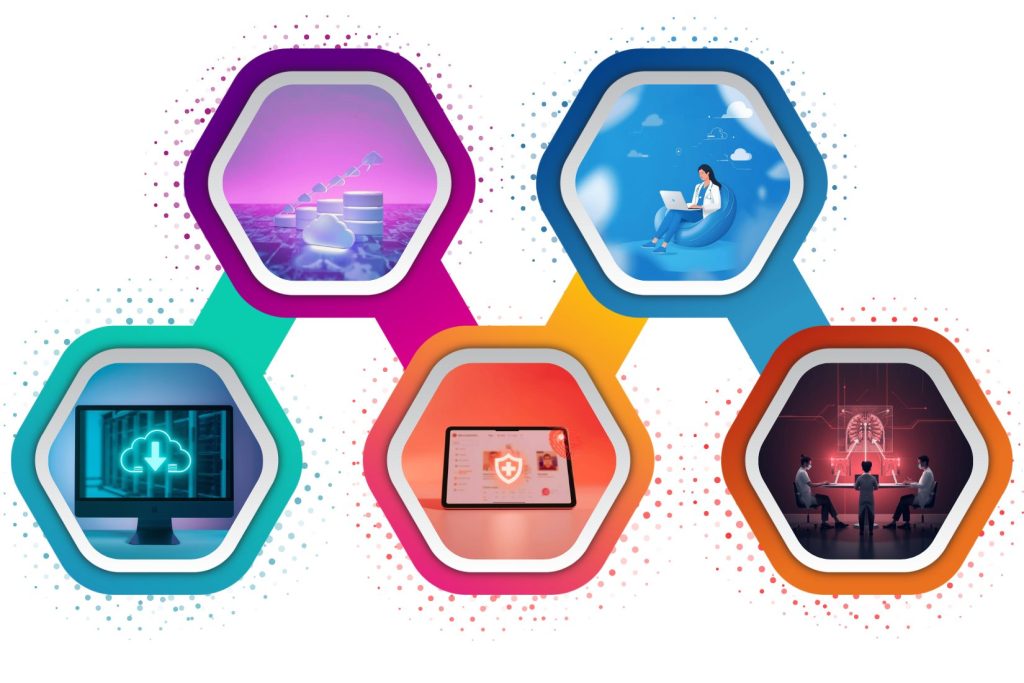
5 Benefits of Using Cloud PACS
For hospitals, these benefits translate into more predictable costs, improved reporting speed, and a stronger foundation for advanced practices like teleradiology and AI-assisted diagnostics.
Cloud PACS vs. Traditional PACS
For many hospitals, the question is not whether to use a PACS solution, but which model best supports their workflow. Traditional PACS systems have been in use for decades and are familiar to many radiologists. However, they come with limitations that can slow down reporting. Hence, the cloud-based PACS makes it more adaptable for multi-branch hospitals and teleradiology practices.
Understand the key differences here:
| Feature | Traditional PACS | Cloud-Based PACS |
| Installation & Setup | Requires local servers, complex IT setup, and high upfront investment. | Quick deployment with no physical servers; accessible through browsers or apps. |
| Accessibility | Limited to hospital network or workstations. | Secure access from any device, anywhere, enabling remote reporting. |
| Scalability | Storage expansion requires buying and maintaining new hardware. | Storage scales automatically as imaging volumes grow. |
| Cost Structure | High capital costs and ongoing IT maintenance. | Predictable subscription or usage-based costs, reducing financial strain. |
| Collaboration | Reporting often limited to one radiologist at a time. | Multiple radiologists can review and report simultaneously in real time. |
| Security & Compliance | Depends on local IT security protocols, which may vary. | Enterprise-grade encryption, regulatory compliance, and role-based access built into the system. |
This comparison shows why many decision-makers are moving toward cloud-based PACS solutions. In simple words, cloud PACS ensures hospitals are prepared for growth, remote collaboration, and the integration of future-ready tools like AI-driven reporting.
How Cloud PACS Supports Teleradiology
Teleradiology has evolved from being an optional service into a core part of hospital workflows. As patient volumes increase and specialists are spread across regions, healthcare providers need imaging systems that go beyond local boundaries. Cloud-based PACS provides exactly that secure, fast, and reliable access to cases, regardless of location.
Secure Remote Access
With cloud PACS, radiologists can review and report cases from any connected device. This breaks the dependency on in-hospital networks and makes it possible for specialists to stay connected even when away from their workplace. In several districts across West Bengal, radiology reporting has been made available to hospitals that previously had no reliable access to full-time specialists. A shift that was nearly unthinkable just a few years ago.
Real-Time Collaboration
Cloud-based PACS allows multiple radiologists and physicians to access the same study at the same time, share annotations, and exchange comments without delays. A chest CT uploaded in one hospital can be reviewed simultaneously by a pulmonologist and a radiologist in two different cities, leading to faster and more confident treatment decisions.
Support for Emergency and Rural Care
Hospitals in rural areas often struggle to find radiologists for late-night or weekend shifts. With cloud PACS, imaging data can be uploaded locally and instantly made available to radiologists elsewhere, ensuring patients receive timely reports. This strengthens emergency teleradiology services, where quick turnaround in trauma or stroke cases can mean the difference between recovery and permanent damage. In critical scenarios, cloud PACS ensures speed and continuity that traditional systems cannot provide.
Scalable Network for Multi-Branch Hospitals
For healthcare groups running multiple branches, cloud PACS ensures every case is part of a centralized archive. Radiologists no longer need to move between isolated systems or wait for files to transfer. A radiologist working from the central hub can switch seamlessly between cases from different branches without losing time or context, strengthening both speed and consistency in reporting.
By integrating these capabilities, cloud PACS makes teleradiology a dependable and central service, helping hospitals extend care across regions while maintaining efficiency and trust in reporting.
PACS Cloud Computing: Its Workflow
For many doctors and administrators, the term cloud computing can sound abstract. In practice, however, cloud PACS computing is straightforward. Instead of relying on hospital-based servers, imaging data flows through secure cloud infrastructure where it is stored, processed, and shared instantly. This system removes technical barriers for clinicians and gives decision-makers confidence that reports are generated efficiently, without downtime or data loss. Below is a simplified view of how the process works:
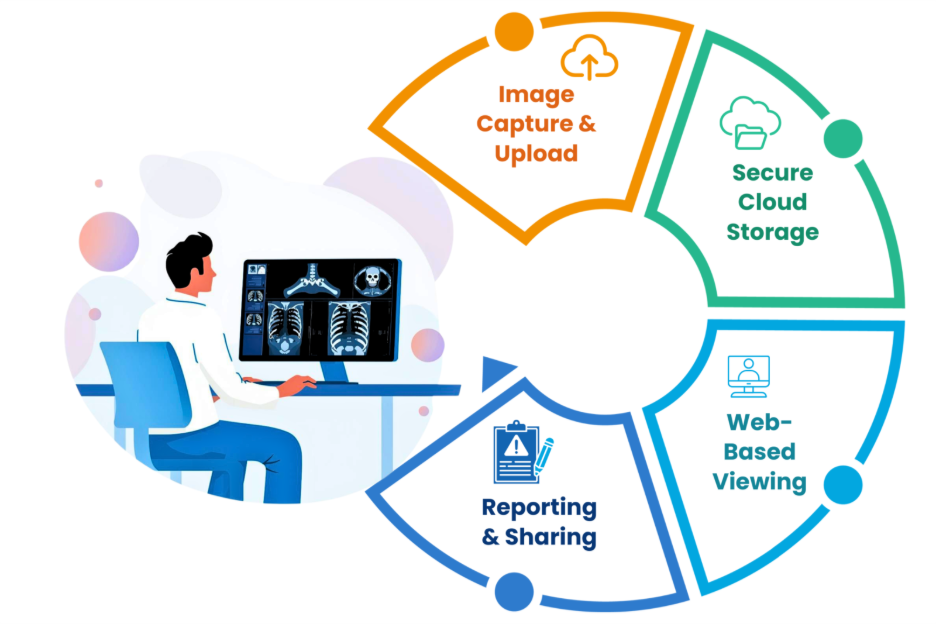
Workflow of PACS cloud computing
Future of Cloud PACS: How Mediog Contributes
The future of radiology depends on systems that are faster, smarter, and more collaborative than what hospitals have traditionally used. Cloud PACS is not only replacing older server-based models but also evolving into a platform that integrates advanced technologies.
Over the coming years, hospitals can expect wider use of AI-assisted reporting, deeper integration with electronic health records, and real-time analytics that help administrators track both clinical and financial performance. These trends are shaping a new generation of PACS solutions that go beyond storage and retrieval to become engines of efficiency and decision-making.
Mediog has been designed with this forward-looking approach in mind. As a cloud-based PACS solution, it combines the strengths of cloud computing with features tailored for hospitals, multi-branch healthcare groups, and individual radiologists. Some of the ways Mediog addresses these future demands include:
- AI-Assisted Structured Reporting – Radiologists can generate accurate, standardized reports quickly, reducing turnaround time and ensuring consistency across cases.
- Secure Cloud Storage and Accessibility – Imaging data is encrypted and available anytime, anywhere, supporting both local workflows and teleradiology services.
- Multi-Branch Scalability – All branches operate on a centralized archive, making it simple to manage thousands of cases without duplicating infrastructure.
- Vendor-Neutral Archiving – Hospitals maintain long-term control of imaging data, avoiding lock-in with any single hardware or software vendor.
- Mobile-Friendly PACS Access – Doctors and radiologists can review cases on desktops, tablets, or smartphones, ensuring continuity of care even outside the hospital setting.
- Financial and Operational Monitoring – Administrators gain real-time insights into reporting activity and costs, helping them make informed strategic decisions.
By aligning with these future trends, Mediog demonstrates how a cloud PACS solution can provide both immediate benefits and long-term stability, giving hospitals and doctors the confidence to adopt new technology without risking disruption to patient care.
Conclusion
Cloud-based PACS is a necessity for hospitals and radiologists who want to keep pace with rising imaging demands and patient expectations. The decision to move from traditional infrastructure to the cloud is also a decision to strengthen accessibility, security, and collaboration for the long term.
For healthcare providers exploring this path, the next step is to choose a solution that balances clinical needs with operational efficiency. Mediog has been built precisely with this balance in mind, offering a cloud PACS solution that is secure, scalable, and designed to adapt to the realities of modern teleradiology. Hospitals and doctors who adopt such a system are not only preparing for today’s challenges but also positioning themselves for the future of radiology practice.
###