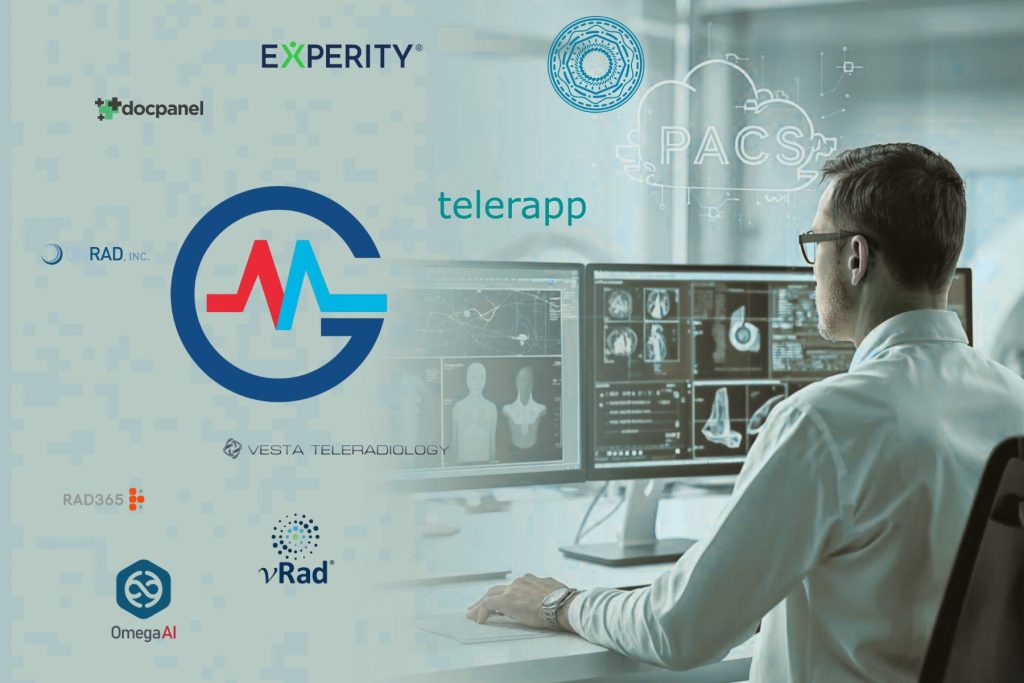
In today’s healthcare system, radiology is no longer limited by physical walls or working hours. A chest scan taken in Kolkata can now be reviewed by a specialist in another city within minutes. This change has been made possible by teleradiology and cloud PACS technology, which connect hospitals, clinics, and radiologists on a single digital network. With the rising demand for faster diagnosis and the shortage of on-site specialists, hospitals are shifting toward remote reporting systems that keep their imaging workflow active round the clock.
But with many platforms offering different tools and integrations, choosing the right one can feel complex. This article helps decision-makers explore the top 11 teleradiology software platforms that make medical imaging faster, safer, and easier to manage.
NB: PACS and MIMPS are systems that store, share, and manage radiology images securely on the cloud. They allow radiologists to access and report cases remotely, improving speed and collaboration. Read our detailed guide on PACS and MIMPS to understand their full role in modern radiology:
Suggested Read: What’s the Role of PACS in Radiology & Medical Imaging?
Suggested Read: What Is MIMPS in Radiology (New Name for PACS?)
Top 11 Teleradiology PACS Software (2026 Ranking)
Modern teleradiology platforms are no longer just remote reading tools. They are complete cloud ecosystems combining PACS, AI, and structured workflows that allow faster diagnosis and 24/7 coverage. Based on usability, reliability, and clinical impact, here are the top 11 teleradiology PACS software platforms in 2026.
#11 – RAD365
RAD365 is a global teleradiology provider serving hospitals and imaging centers across North America, Europe, and India. Built with AI-enhanced workflow and cloud-native architecture, it offers full 24×7 coverage and fast turnaround for emergency and routine studies. Hospitals value its 99.99% accuracy rate achieved over 1.7 million reads, backed by a network of 100+ certified radiologists. It’s ideal for institutions looking for consistent quality and subspecialty access without investing in heavy infrastructure.
| Pros | Cons |
| Hospitals appreciate its strong accuracy and reliability. Studies are reported within 15 minutes in emergency cases, helping smaller centers match tertiary hospital standards. | The service is priced on a case-by-case basis with no published structure, making budgeting difficult for smaller hospitals. |
| The AI-assisted reporting reduces manual load for radiologists and ensures consistency across reports. | Integrating RAD365 with existing PACS or EMR systems can require custom interfaces or technical assistance. |
| Offers affordable global subspecialty reads from U.S. and U.K. certified radiologists. | As a smaller provider, it may have limited scale compared to larger global networks. |
#10 – vRad (Virtual Radiologic)
vRad is one of the world’s largest teleradiology networks, reading for more than 2,100 facilities with a team of over 500 radiologists. It is known for speed and scale, often delivering emergency reads within 10–12 minutes. The platform integrates over 25 AI models that assist in case triage and prioritization, ensuring radiologists focus on critical studies first. For large hospitals, vRad represents operational dependability with enterprise-level analytics and reporting transparency.
| Pros | Cons |
| Known for rapid turnaround, averaging under 12 minutes for trauma and STAT cases, ensuring better emergency outcomes. | The platform’s fast-paced workflow can feel demanding, with little flexibility in scheduling for radiologists. |
| Seamless integration with HL7/FHIR standards allows easy connectivity with existing RIS/EHR systems. | Its large size can make smaller hospitals feel less prioritized, as service tends to be uniform and corporate. |
| Scalable for multi-facility hospital networks; data analytics support performance tracking and compliance audits. | Complex contracting and onboarding processes can delay deployment, especially for smaller setups. |
#9 – ONRAD
ONRAD is a U.S.-based, physician-owned teleradiology company known for its transparent operations and radiologist-first culture. It offers both preliminary and final reads across all 50 states and recently expanded after acquiring Direct Radiology in 2025. ONRAD’s transparency stands out, it publishes its turnaround times and QA metrics publicly, which appeals to administrators seeking accountability and measurable performance.
| Pros | Cons |
| Physician-led approach ensures decisions prioritize clinical quality over volume, fostering long-term trust. | As a mid-sized player, its IT interface may lack some refinements seen in larger, tech-heavy systems. |
| Turnaround and QA data are publicly available, helping hospitals validate service quality. | While transparent, the open display of metrics can create perceived pressure among radiologists. |
| Offers custom workflows, including hybrid models combining on-site and remote coverage. | Still limited in scale for very large hospital networks operating across multiple states. |
#8 – DocPanel
DocPanel operates on a marketplace model, connecting diagnostic centers directly with subspecialty radiologists on a per-case basis. Instead of fixed contracts, hospitals can choose their preferred radiologists for specific studies, allowing more control and flexibility. It’s best suited for small or mid-sized centers that occasionally need expert reads without maintaining an in-house team.
| Pros | Cons |
| Gives hospitals access to academic-level specialists for complex or rare cases, improving diagnostic depth. | Not designed for 24/7 emergency reading; turnaround is typically around 24 hours. |
| Pay-per-read model avoids long-term commitments, ideal for small diagnostic units or clinics. | Case volume and turnaround may vary since radiologists work independently within the platform. |
| Direct communication between radiologists and referring doctors improves collaboration and report clarity. | For high-volume centers, per-case pricing may become costlier than a traditional contract. |
#7 – Experity
Experity specializes in urgent care teleradiology, integrating its EMR with the OnePACS system for rapid image sharing. The platform handles over five million annual studies across 3,500+ clinics. With turnaround times averaging 21 minutes for routine and 10 minutes for STAT cases, it helps urgent care centers provide near-instant radiology reports, often before the patient leaves the clinic.
| Pros | Cons |
| Extremely fast reporting improves patient satisfaction and clinic throughput. | Limited focus — primarily suited for urgent care imaging, not advanced modalities like MRI or PET. |
| AI-driven checks provide high accuracy, minimizing misreads and legal risk. | Non-urgent-care hospitals might find integration or independent onboarding more complex. |
| Seamlessly integrates with EMRs, enabling smooth report delivery and ROI for fast-paced care setups. | Subscription or bundle pricing may not suit very low-volume facilities. |
#6 – Telerapp
Telerapp is a new-generation teleradiology startup blending cloud PACS with AI-driven automation. Recognized among the top AI healthcare startups in 2024, its “Quantum” cloud suite enables hospitals to manage imaging, storage, and reporting in one place. Telerapp’s AI tools pre-analyze images and prioritize cases, helping radiologists focus on critical studies first.
| Pros | Cons |
| AI integration helps pre-screen studies, improving turnaround time and reader efficiency. | As a young company, it is still developing its large-scale infrastructure and regulatory certifications. |
| Offers flexible pricing and full 24×7 global radiologist coverage. | Integration with legacy EMRs may need custom support during setup. |
| The cloud PACS platform provides scalability for hospitals that prefer to avoid physical servers. | As a growing platform, case volume and client base are still expanding, which may affect consistency. |
#5 – Vesta Teleradiology
Vesta is a U.S.-based teleradiology group offering nationwide coverage for hospitals and mobile imaging providers. With over a decade of experience, Vesta combines a strong subspecialty team with a customer-focused approach. Their in-house PACS integrates seamlessly with client systems, and reports can be customized to match a hospital’s style for consistent branding and communication.
| Pros | Cons |
| U.S.-based board-certified radiologists ensure compliance and smooth communication with local physicians. | Smaller scale compared to vRad means limited nationwide redundancy. |
| Offers detailed, customized reporting formats and 24/7 subspecialty coverage. | Pricing transparency is limited; clients must request custom quotes. |
| Strong integration capabilities minimize workflow disruption for hospitals adopting their system. | Occasional management and communication challenges have been reported internally. |
#4 – TeleRad Providers (TRP India)
TeleRad Providers (Prime Telerad Providers Pvt. Ltd.) is one of India’s earliest teleradiology networks, founded in 2007. It delivers accurate reads at low cost, serving Indian and international hospitals. The platform supports 3D post-processing and subspecialty reads, making it ideal for small diagnostic centers and regional hospitals. Its “Rad Learning” initiative also promotes education and mentorship for radiologists.
| Pros | Cons |
| Offers economical yet reliable teleradiology services, especially for small hospitals in India. | May not fully meet the compliance standards required by U.S. or EU hospitals. |
| Enables hospitals without full-time radiologists to maintain 24/7 reporting coverage. | Connectivity and data latency can affect turnaround when transmitting large imaging files. |
| Provides educational programs and 3D post-processing as value-added services. | Integrations with hospital IT systems are more basic and might require manual uploads. |
#3 – Jankharia Imaging Cloud PACS
Founded by Dr. Bhavin Jankharia, this Mumbai-based practice pioneered teleradiology in India in 1996. Their cloud PACS, “Picture This,” connects multiple centers, enabling real-time reporting and subspecialty collaboration. It’s one of the most trusted systems in India, known for accuracy, secure storage, and radiologist-designed usability.
| Pros | Cons |
| Proven credibility and reliability with decades of experience in radiology IT. | Primarily regional; less suited for international deployment or large-scale networks. |
| Cloud PACS reduces infrastructure costs and allows multi-center access without on-site servers. | Documentation and feature support may be limited compared to commercial vendors. |
| AI and 3D visualization tools enhance diagnostic capabilities and efficiency. | Dependence on Jankharia’s hosting means uptime and scalability must be verified for large use. |
#2 – RamSoft OmegaAI
RamSoft OmegaAI is a next-generation, cloud-native PACS and RIS solution built on Microsoft Azure. It uses “Progressive Loading” technology to stream even large CT or MRI studies instantly within a browser. The system includes embedded AI for triage and report automation, helping hospitals scale quickly without maintaining servers. Despite its innovation, reviews suggest careful evaluation of customer support and contractual terms.
| Pros | Cons |
| Zero-footprint architecture eliminates the need for local servers and VPNs. | Some users reported weak technical support and contract rigidity. |
| Progressive Loading allows faster access to large imaging studies, improving report turnaround. | Early adopters experienced occasional system instability and slow bug resolution. |
| Fully integrates AI for prioritization, labeling, and workflow automation. | Long-term subscription pricing can become expensive if advanced tools are underutilized. |
#1 – Mediog Labs
Mediog leads this list as a complete radiology ecosystem, uniting PACS, RIS, and Teleradiology on one secure, cloud-based platform. Designed in India for global hospital networks, Mediog enables radiologists to read, report, and collaborate from any device. It combines browser-based 3D/MPR visualization, automated reporting tools, and real-time financial dashboards for total workflow visibility.
Many reputed hospitals and diagnostic centers, including Dishari Health Point, Desun Hospital, Suraksha Clinic & Diagnostics, Gooddays Diagnostic, Kolkata Kidney Institute, and Apollo Diagnostics, already use Mediog’s cloud PACS for daily reporting and secure data access.
| Pros | Cons |
| Combines PACS, RIS, and teleradiology in one platform, removing the need for multiple vendors. | As a growing ecosystem, integration with certain legacy HIS systems may require onboarding support that is provided duly. |
| Browser-based, mobile-friendly interface allows access from anywhere, ensuring flexibility. | |
| Built-in AI, structured reporting, and real-time financial analytics make it a complete radiology solution. | |
| Trusted by top Indian hospitals for its stability, speed, and workflow simplicity. |
Why Would You Choose Mediog?
For hospitals and diagnostic centers, reliability matters more than features. Mediog brings both: a unified platform that keeps imaging, reporting, and communication running seamlessly 24/7. It’s not just software, but a system that hospitals trust to keep their radiology departments active even at midnight or during peak workloads.
Here’s why Mediog stands out:
- 24/7 Dedicated Support: Round-the-clock technical help ensures zero downtime, even during night or emergency hours.
- All-in-One Cloud Platform: Combines PACS, RIS, and teleradiology in one system for a smooth, connected workflow.
- Secure and Encrypted Data: Every image and report is protected with hospital-grade encryption, ensuring complete data privacy.
- AI-Powered Workflow: Automates prioritization and structured reporting, reducing delays and fatigue for radiologists.
- 3D/MPR Visualization: Enables advanced interpretation directly from the browser without local software.
- Trusted by Leading Hospitals: Used daily by Dishari Health Point, Desun Hospital, Suraksha Clinic & Diagnostics, Gooddays Diagnostic, Kolkata Kidney Institute, and Apollo Diagnostics.
Mediog helps hospitals deliver faster, safer, and smarter diagnostics with confidence that their system never sleeps.
Conclusion
Hospitals today face a clear choice, either keep managing disconnected radiology systems or move to a unified platform that runs efficiently without interruption. Mediog offers that path forward. With secure cloud access, instant collaboration, and 24/7 support, it helps healthcare teams focus on what truly matters: timely, accurate diagnoses. For decision-makers seeking a dependable, future-ready radiology solution, Mediog stands as the most practical step toward connected, round-the-clock imaging care.
###