Emergency cases do not wait for daylight or weekdays. When hospitals face sudden trauma, stroke, or cardiac emergencies at odd hours, the challenge is not only medical but logistical. Traditional radiology setups often depend on limited on-site availability of radiologists, which delays image interpretation and impacts critical care decisions. This is where emergency teleradiology becomes indispensable. By allowing radiologists to access and report diagnostic images remotely, hospitals can ensure timely decisions, even when local facilities are closed or staff are off duty.
In India, 24/7 teleradiology services for emergency departments are rapidly becoming the norm. Platforms like Mediog make this possible by combining a secure cloud-based teleradiology platform with instant access to imaging data, reliable PACS-RIS integration, and mobile-friendly reporting tools. Leading institutions such as Desun Hospital have already implemented Mediog emergency teleradiology services to ensure uninterrupted coverage and faster turnaround. The result is a workflow that stays active around the clock, connecting doctors, patients, and radiologists even when the hospital lights are dim.
Why Night & Weekend Radiology Coverage Is a Challenge
Hospitals cannot slow down when emergencies arrive at 2 a.m. or on a Sunday. Yet the realities of staffing, fatigue, and financing make after hours teleradiology coverage difficult to sustain at high quality. Below are the most common pain points that leaders weigh while trying to deliver reliable night teleradiology coverage and weekend radiology services.
Diagnostic accuracy drops at night.
Fatigue and circadian misalignment increase interpretation errors during overnight reading. A Mayo Clinic analysis showed CT discrepancy rates rising from roughly 2% in regular hours to 3% at night, peaking near 3.7% in early mornings, with fatigue cited as a driver of off-hour errors. The quality risk is real for emergency teleradiology reporting when every minute matters (Source: radiologybusiness.com).
Turnaround times stretch during off-hours.
When in-house radiologists are unavailable, reports wait longer, ED stays lengthen, and time-critical decisions are delayed. The “weekend effect” links reduced access to services with slower treatment and worse outcomes; delays in interpreting critical CT findings can postpone stroke therapy or surgery, directly affecting recovery (Source: droracle.ai). Reliable 24/7 teleradiology services for emergency departments are used to counter these lags (Source: radiologybusiness.com).
Preliminary reads create callback risk.
Many sites rely on provisional overnight interpretations with final reads next day. A Level I trauma center saw ED imaging callbacks fall by 89% after moving to 24/7 attending coverage, improving safety and reducing repeat visits. ED clinicians also reported better confidence and workflow when final reports were immediately available for urgent surgical decisions (Source: radiologybusiness.com).
Recruitment & retention are tough for nights.
Radiologists increasingly decline lucrative night and weekend shifts to protect health and family time. Physicians openly note that no pay offsets the long-term toll of overnight work, making it harder to staff consistent off-hour rotations for teleradiology emergency department needs. The culture shift limits the pool for dependable after-hours coverage (Source: radiologybusiness.com).
Burnout & fatigue drive turnover.
Surveys show burnout as a top concern, with many radiologists linking overnight duty to impaired performance and accuracy. More night shifts correlate with higher burnout risk, and some groups report resignations shortly after assigning new overnight rotations, underscoring the sustainability problem of continuous coverage (Source: allamericanrad.com; pmc.ncbi.nlm.nih.gov; diagnosticimaging.com; radiologybusiness.com).
Schedules feel unfair and recovery is inadequate.
A 2025 survey in Emergency Radiology found over half of respondents worked nights or evenings, with many rating the workload unmanageable, compensation inadequate, and recovery time insufficient. The authors urged systemic fixes to recruit and retain overnight readers for emergency teleradiology (Source: radiologybusiness.com).
Costs climb while reimbursement lags.
Night and weekend coverage requires premiums for undesirable hours or outsourcing to teleradiology firms, raising operating expense. Median U.S. radiologist compensation has climbed sharply, while off-hour reads often lack enhanced reimbursement, forcing hospital subsidies to maintain 24/7 service viability and radiology turnaround time improvement targets (Source: pmc.ncbi.nlm.nih.gov; spectrummsc.com).
Teleradiology contracts can strain budgets.
Per-study rates and high monthly minimums have escalated, with some contracts jumping from about $5,000 to $25,000+ minimums regardless of volume. Vendor staffing gaps can trigger sudden “take back” requests, pushing day teams into unplanned night duty and accelerating burnout. Switching vendors risks service disruption due to credentialing and IT lead times (Source: diagnosticimaging.com).
Global workforce shortages magnify the gap.
In 2023, about half of U.S. radiology job openings reportedly went unfilled. UK departments missed imaging wait-time targets in 2024 due to staffing shortfalls. The shortage makes continuous coverage hard even for top teleradiology providers for emergency centers (Source: aag.health).
Technology helps, but demands infrastructure.
Teleradiology enables centralized night coverage, multi-site reading, and follow-the-sun models that keep radiologists alert in their daytime, improving accuracy and speed. Success depends on fast, secure image transfer and tight communication workflows to relay critical results without friction (sciencedirect.com; axisimagingnews.com; pubmed.ncbi.nlm.nih.gov). AI triage can flag hemorrhage, PE, or pneumothorax and predict delays, helping prioritize worklists, although real-world workload reduction remains limited so far (Source: radiologybusiness.com).
How Teleradiology Keeps Emergency Services Running 24/7
When emergency cases arrive after midnight, hospitals depend on teleradiology to keep diagnostic services active. It bridges the coverage gap by connecting on-site clinicians with remote radiologists through a secure digital workflow. Here’s how emergency teleradiology ensures fast, continuous, and reliable reporting.
Remote Access to Imaging Data Anytime, Anywhere
Modern PACS systems allow radiologists to log in securely from home or another facility and view patient scans instantly. Whether it is a trauma CT or a cardiac MRI, images are uploaded to the cloud-based teleradiology platform, ready for immediate review by the on-call specialist.
Rapid Reporting for Critical & Trauma Cases
Emergency CT, MRI, and X-ray images can be read within minutes. Once the scan is reviewed, the emergency teleradiology reporting system automatically sends the signed report to the emergency department, improving radiology turnaround time and enabling faster treatment.
Collaboration Between On-Site Doctors & Remote Radiologists
When urgent findings appear, the teleradiologist can instantly alert the attending physician or surgeon through integrated messaging and alert systems. This remote radiologist reporting workflow ensures that life-saving interventions are never delayed due to distance or staffing limits.
Specialized Reads Across Multiple Time Zones
Hospitals can assign night reads to radiologists in other regions, ensuring that someone is always working in their local daytime hours. This “follow-the-sun” model improves accuracy and eliminates fatigue-related errors common in after hours teleradiology.
Secure Cloud & Data Encryption
Each image and report is transferred through encrypted channels. Compliance with data protection protocols ensures that remote radiology reporting for hospitals remains both fast and fully secure for patient privacy.
The Mediog Advantage in Night and Weekend Coverage
Providing continuous diagnostic coverage requires more than just technology, it needs a system that unites reliability, speed, and accessibility. Mediog teleradiology software is built for that exact purpose. Designed to keep hospitals operational through the night and on weekends, Mediog integrates secure cloud PACS and RIS systems that allow radiologists to read, report, and share results from anywhere. This isn’t theoretical convenience; it’s already in practice across leading institutions.
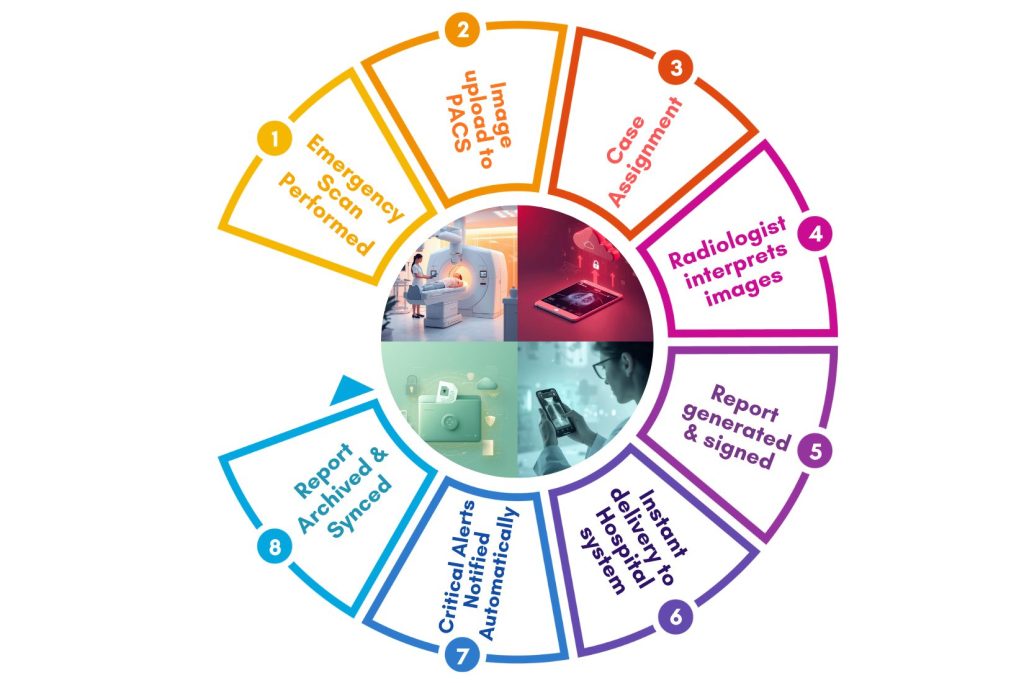
Desun Hospital and Apollo Diagnostics, for instance, use Mediog emergency teleradiology services to maintain round-the-clock image reporting. Even during low-staff hours, emergency CTs or MRIs are instantly uploaded to the Mediog cloud, where authorized radiologists can access them remotely through their laptops or tablets. Within minutes, reports are delivered back to the emergency department, ensuring decisions are made without waiting for morning shifts. This rapid, secure process has significantly reduced reporting delays, a problem that once affected weekend and overnight care.
Meanwhile, radiologists such as Dr. Aroon Kumar Chatterjee and Dr. Ajit Biswal use Mediog’s mobile teleradiology platform to manage urgent reads when away from the hospital. They can open scans, annotate findings, and share reports with attending physicians in real time. This flexibility means a radiologist can assist multiple facilities simultaneously, improving overall turnaround and expanding access to expert review, especially during critical hours when traditional setups would struggle.
At Dishari Health Point and Suraksha Clinic & Diagnostics, Mediog’s cloud synchronization keeps all branches connected. Whether an image originates in one unit or another, it’s instantly available to specialists through Mediog’s secure system. Hospital administrators have noted that this cloud-based teleradiology platform not only ensures timely reporting but also minimizes manual coordination between branches. This unified workflow is especially valuable for after hours teleradiology, when staffing is minimal but the need for precision is maximum.
Radiologists like Dr. Jiyon Sen, Dr. Kingshuk Mondal, and Dr. Raman Sau highlight another key advantage, Mediog’s intuitive PACS-RIS integration. It’s more than a remote reading tool; it’s an end-to-end reporting environment where case tracking, communication, and patient data remain centralized and traceable. Reports are securely archived, ensuring both transparency and compliance with healthcare data standards.
In essence, Mediog transforms the fragmented model of overnight reporting into a cohesive, always-on ecosystem. Every participating hospital and radiologist benefits from the same seamless continuity:
- Real-time access to imaging data regardless of location or hour.
- Multi-branch synchronization for hospitals with distributed setups.
- Mobile-ready access for specialists managing multiple centers.
- Automated report routing that ensures every finding reaches the right physician instantly.
By bridging technology with reliability, Mediog ensures that emergencies never wait for office hours. For hospitals, this means uninterrupted patient care; for radiologists, it means flexible, fatigue-free working conditions. Together, they define the new standard in 24/7 teleradiology services for emergency departments.
Conclusion
The demand for round-the-clock diagnostic care is no longer optional; it is essential for patient safety and hospital efficiency. Emergency teleradiology bridges that gap, ensuring accurate reads at any hour without overburdening staff. Mediog brings this capability to life with a dependable, cloud-based system trusted by hospitals and radiologists alike. For healthcare leaders aiming to maintain continuous, high-quality imaging coverage, adopting Mediog emergency teleradiology services is the most practical step forward.
###