
Radiology reports play a decisive role in guiding treatment plans and confirming diagnoses, but preparing them often remains slow and repetitive. Even with structured formats in place, radiologists frequently re-edit prior findings or adapt lengthy descriptions to match a new study. This repetitive process increases workload and leaves room for inconsistencies that can affect clarity.
AI reporting addresses these challenges by generating one-click drafts from prior reports, combining accuracy with speed. Instead of spending valuable time on repetitive documentation, radiologists can focus more on interpretation and patient outcomes. For hospitals, this means consistent reporting standards, faster delivery of CT, MRI, or X-ray results, and stronger confidence in daily operations.
What is AI Reporting for Radiologists?
AI reporting in radiology is built to support doctors in preparing structured reports quickly, without replacing their judgment. The system does not analyze prior reports or interpret findings. Instead, it accesses earlier reports if available, follows the radiologist’s directions, and automatically prepares a draft on the preferred reporting template.
This workflow ensures that radiologists remain in full control while saving time on repetitive documentation. By simplifying drafting, AI reduces clerical workload, improves consistency across CT, MRI, and X-ray reports, and allows doctors to focus more on the core task of image interpretation and clinical decision-making.
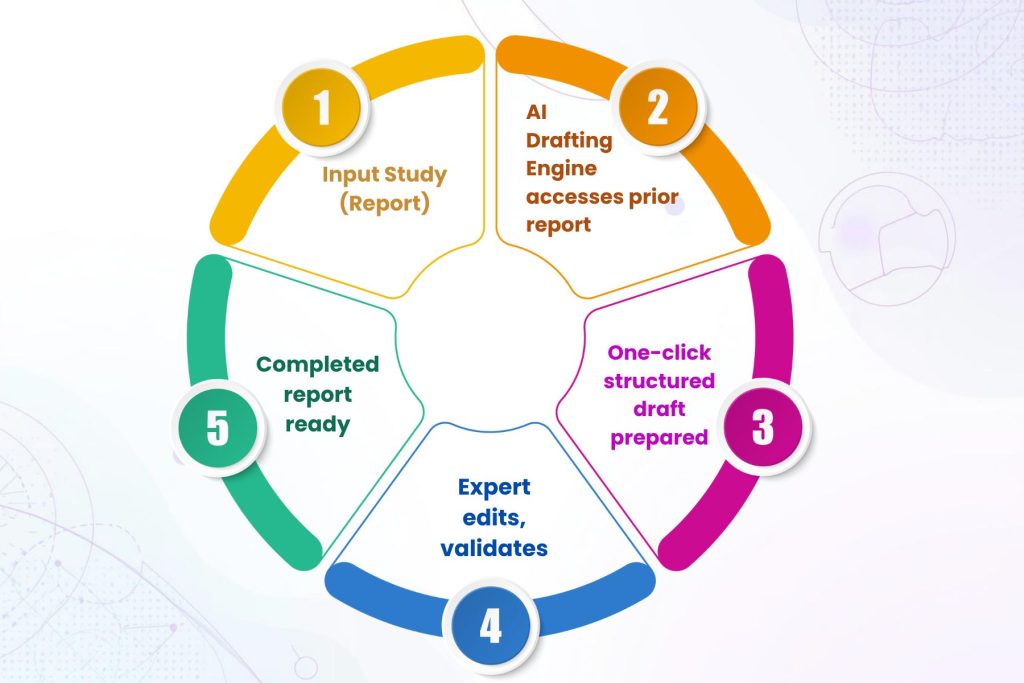
How Can Prior Radiology Reports Become One-Click Drafts?
Traditional reuse of prior reports often risks errors, but AI reporting solves this by automatically preparing a structured draft on the chosen template. If earlier reports are available, the AI can access them for reference, while the radiologist’s directions guide what goes into the draft.
- Template Application: AI prepares the draft directly on the preferred reporting template, reducing repetitive typing for CT, MRI, or X-ray reports.
- Reference Access: If prior reports exist, they can be attached for reference, but the final content is based on the radiologist’s instructions rather than automated analysis.
- Structured Output: Drafts maintain a consistent style across different modalities, improving clarity and standardization for hospital teams and referring physicians.
- Editable Drafts: Radiologists can freely review, adjust, or expand the draft, keeping clinical accuracy and decision-making entirely in human hands.
Are AI-Generated Drafts Safe to Avoid Copy-Paste Errors?
Radiologists often rely on copy-paste to speed up reporting, especially when findings appear similar to previous studies. But this practice carries risks: outdated details may slip in, important observations may be missed, and inconsistencies can weaken the clarity of a report. Over time, such errors can compromise both patient care and institutional reliability. AI-generated drafts address these issues by creating structured reports directly on the chosen template, guided by the radiologist’s directions. The process ensures speed without relying on risky shortcuts.
- Error Reduction Through Drafting Support: Instead of copying old text, the AI builds a fresh draft aligned with the radiologist’s instructions. This reduces the chance of outdated or irrelevant details being carried over.
- Consistency Across Reports: Drafts are automatically created in structured formats, whether for a CT scan report, MRI report, or chest X-ray report. This standardization improves clarity and communication between departments and referring physicians.
- Human Oversight Built In: AI never finalizes a report on its own. Every draft remains editable, giving radiologists full authority to refine, expand, or add critical observations. Clinical accuracy stays under expert control.
- Support for Compliance and Quality: Some AI radiology software also tracks edits within the reporting workflow, helping hospitals maintain accuracy records, streamline processes, and demonstrate adherence to quality standards.
Benefits of Smart Reporting in Daily Radiology Practice
AI reporting is not just about speed; it transforms how radiologists, physicians, and hospital teams interact with reports. By combining automation with structured output, AI ensures quality while reducing workload. Below are some key benefits that directly impact daily practice.
1. Faster Turnaround of Reports
AI-generated drafts significantly reduce the time taken to prepare a CT scan report or chest X-ray report. Instead of starting from scratch, radiologists review and finalize within minutes. This faster turnaround helps hospitals manage higher patient volumes without compromising on quality, especially in emergency care where quick reporting is critical. For institutions offering tele reporting radiology services, AI-generated drafts help radiologists deliver CT or X-ray reports faster, even when cases are handled remotely.
2. Consistency Across Templates
Traditional radiology reporting templates often vary between individuals, leading to differences in terminology. AI reporting standardizes formats, whether it’s an MRI report format or an X-ray report, ensuring that referring physicians always receive reports in a consistent structure. This improves communication and builds trust between departments.
3. Reduced Cognitive Load for Radiologists
By turning prior reports into editable drafts, AI reduces repetitive documentation. Radiologists no longer need to manually retype findings or adjust long descriptions. Instead, they can focus more on image interpretation and clinical decision-making, which benefits both doctors and patients by improving diagnostic accuracy.
4. Higher Reliability for Hospitals
Hospitals benefit from AI reporting by ensuring every radiology report is accurate, standardized, and error-checked. For administrators, this means fewer complaints about unclear findings and stronger compliance with institutional standards. Over time, consistent reporting also strengthens hospital reputation, especially when delivering premium imaging results for complex cases.
Real-World Examples: CT, MRI, and X-Ray Reports
AI reporting is not limited to one type of imaging; it adapts across modalities to suit specific needs. By learning from prior reports and following structured formats, it creates drafts that resonate with daily practice.
AI-assisted CT Scan Report
In trauma cases, CT scans often generate lengthy descriptions covering multiple regions. AI reporting extracts relevant details from earlier cases, generates structured drafts for the current study, and ensures findings are neatly categorized by organ or system. This speeds up emergency reporting where every minute matters.
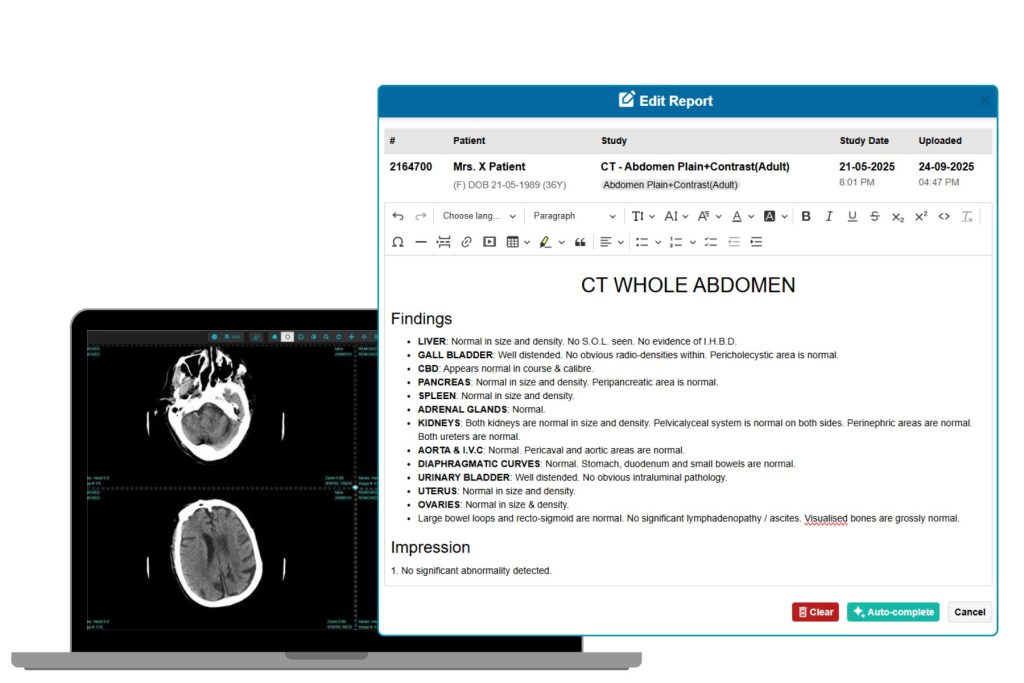
Mediog’s CT image & report
AI-assisted MRI Report
An MRI report format often requires detailed observations on soft tissues, contrast studies, and subtle abnormalities. AI-driven drafting preserves this complexity while maintaining a uniform style. Radiologists benefit by avoiding repetitive phrasing across multiple scans and ensuring consistency in follow-up studies, particularly in neurology and musculoskeletal imaging.
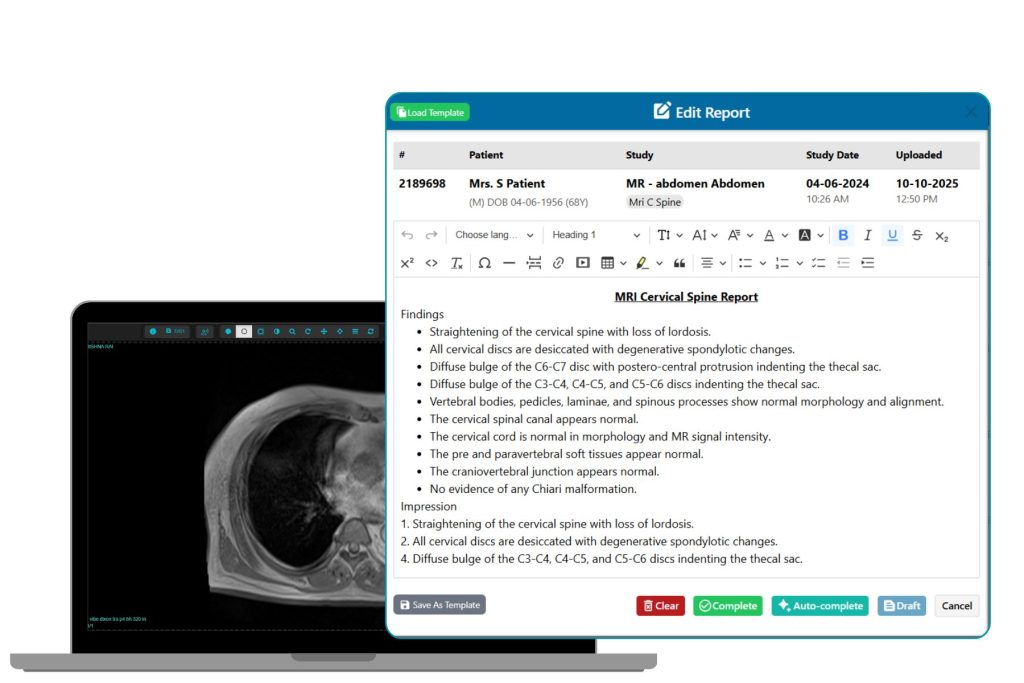
Mediog’s MRI image & report
AI-assisted Chest X-Ray Report
Chest X-ray reports are among the most frequent, but also the most prone to repetitive copy-paste errors. In many hospitals, chest X-ray reports form the bulk of online X ray reporting, where AI ensures each draft reflects patient-specific findings rather than generic copy-paste text. AI reporting ensures each draft reflects the specific patient’s findings rather than generic text. For example, it highlights changes in lung fields or cardiac silhouette when compared with prior studies, ensuring accuracy in serial monitoring.
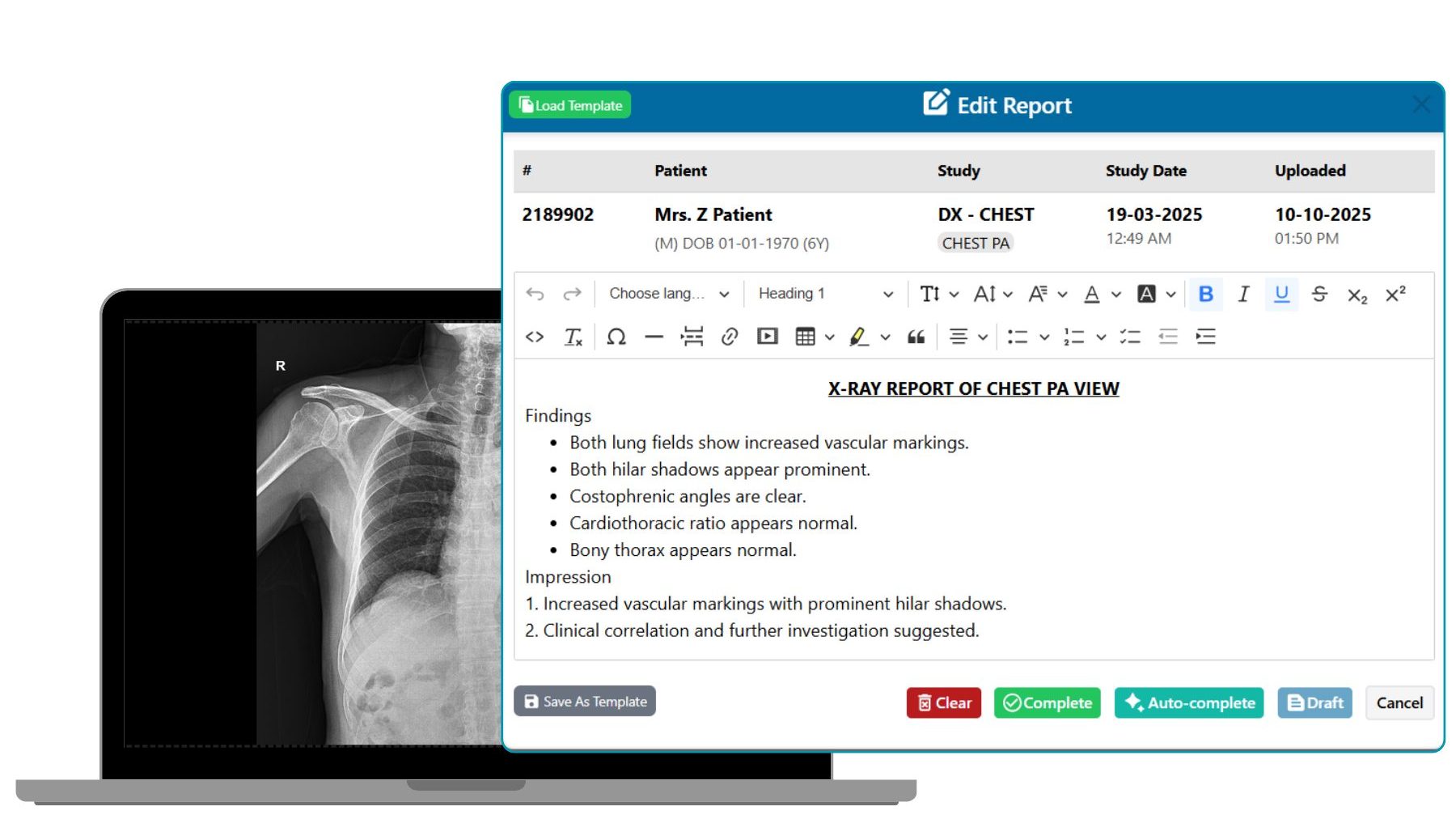
Mediog’s Chest X-ray image & report
How AI Fits into Radiology Workflows?
Integrating AI reporting into daily workflows is not about replacing radiologists but about reducing repetitive documentation tasks. The AI does not interpret or analyze studies; instead, it prepares drafts on predefined templates based on the radiologist’s directions. When connected with PACS or teleradiology software, this drafting process works seamlessly across branches and remote practices, without disrupting established operations.
- Integration with Imaging Systems: AI radiology software links with PACS and RIS to access prior reports if available and apply reporting templates. This ensures drafts are generated in line with existing hospital data structures.
- Time-Saving in Routine Cases: For high-volume tasks such as preparing an X-ray report, the AI quickly generates drafts on the template, allowing radiologists to spend more time on complex CT or MRI interpretations.
- Support for Collaboration: AI-generated drafts use standardized language and formats, which improves communication among referring physicians, specialists, and multidisciplinary teams.
- Scalability Across Departments: Whether in a single-practice clinic or a large hospital network, AI-assisted drafting adapts to varying workloads, helping institutions manage increasing case volumes while maintaining consistent quality.
Traditional Templates vs. AI-Driven Reporting
| Aspect | Traditional Radiology Reporting | AI-Driven Reporting |
| Speed of Report Creation | With traditional radiology reporting templates, radiologists often spend considerable time filling in repetitive sections, especially for CT scan reports or MRI report formats. The process remains time-intensive and slows down overall workflow. | AI-driven reporting generates one-click drafts from prior reports, reducing time for repetitive documentation. A chest X-ray report or CT scan report can be prepared in minutes, allowing radiologists to focus more on interpretation. |
| Accuracy and Error Risk | Copy-paste practices used with templates may bring forward outdated findings, leading to inaccuracies in an X-ray report or follow-up case. Human fatigue further increases the chances of error. | AI reporting minimizes errors by filtering irrelevant details and creating context-specific drafts. Each radiology report is generated afresh, with accuracy ensured by both structured output and radiologist validation. |
| Consistency Across Reports | Reports prepared from templates often vary between individuals, making it difficult to maintain consistent terminology across MRI report formats, CT scan reports, or chest X-ray reports. | AI-driven reporting ensures standardized language and format across all modalities, offering uniformity in radiology reports that improves communication with referring physicians and hospital teams. |
| Impact on Radiologist Workload | Traditional templates reduce some effort but still demand manual adjustments and repetitive entries. Radiologists spend valuable time documenting instead of analyzing images. | AI reporting directly reduces workload by handling repetitive drafting. Radiologists review and finalize the AI draft, shifting their focus toward interpretation and patient care rather than documentation. |
| Institutional Reliability | Hospitals relying only on templates often face variations in report quality, making it harder to assure consistent standards across departments and branches. | AI reporting delivers structured, accurate, and uniform radiology reports, helping hospitals maintain strong institutional credibility and compliance while managing larger volumes of imaging studies. |
Conclusion
AI reporting is no longer a future concept. It is becoming a practical solution for radiologists and hospitals striving to balance speed, accuracy, and consistency. For decision-makers, the question is not whether AI will fit into workflows, but how quickly its benefits can be realized in daily reporting. Mediog’s platform is built to bridge this gap, combining AI-driven reporting with secure PACS and RIS integration.
For hospitals moving toward online radiology reporting, Mediog provides a secure platform where AI reporting blends seamlessly with daily workflows. If your institution is considering the next step in radiology, exploring Mediog’s AI-enabled reporting could be the safest and most efficient path forward.
###